How Hillary can appear more trustworthy.
-- MidWeek, May 13, 2015
Wednesday, May 20, 2015

Tuesday, May 12, 2015
Hawaiian Electric and solar
[5/12/15] Oahu's rooftop solar industry returned to growth in the past two months after two years of declines.
[2/20/15] Solar industry representatives said Thursday they blame Hawaiian Electric Co. for 400 lost solar jobs in 2014.
The Alliance for Solar Choice, a solar lobbying group, said the slow utility approval for customers looking to get rooftop solar led to the loss of solar-related jobs in Hawaii.
The Solar Foundation, a national nonprofit, said earlier this month there were 2,200 solar workers in Hawaii at the end of 2014, down from 2,600 in 2013.
In September 2013 HECO changed its policy, requiring customers to be approved by the utility before installing rooftop solar. HECO has been slow to approve rooftop photovoltaic systems in neighborhoods where it said solar power has reached 120 percent capacity. In the past, HECO said exceeding 120 percent could be dangerous to homes and the grid.
[10/10/14] The state blasted Hawaiian Electric Industries' new energy transition plan for being stuck in the past and doing more to benefit the utility than the public.
[9/20/14] Legislators scolded Hawaiian Electric Co. on Friday for slowing down the adoption of rooftop solar power systems, saying the delays could mean residents will miss out on a lucrative federal tax incentive.
There are 4,500 people waiting for solar approval as a result of a September 2013 rule change where HECO required customers and contractors to be approved by the utility before installing photovoltaic systems.
PV installation permits plunged 67 percent in August from the year-earlier period and were down more than 80 percent from the all-time monthly high in October 2012.
"This is a case where a serious tax credit that is helping our constituents throughout the islands is going to lapse," said state Rep. Cynthia Thielen (R, Kailua-Kaneohe Bay).
A 30 percent federal tax credit available to HECO customers who install solar systems ends Dec. 31, 2016. There is also a state tax credit for PV system installations of 35 percent up to $5,000 per system, which doesn't have an expiration date.
HECO has said it needs to slow down the addition of more rooftop solar systems because the rapid increase in PV installations in the past few years has caused concern about the stability of the electric grid.
"You should have known two years ago that it was going to go beyond what you can take," said state Sen. Donna Mercado Kim (D, Kalihi-Moanalua-Halawa) at a state Capitol briefing. "You should have figured that out. The more we give incentives, the more we give tax credits, the more you are going to encourage people, and that was the plan, encourage people. So I don't understand why we are here."
Jim Alberts, HECO senior vice president of customer service, responded that the company is looking for fixes but needs time.
"There is a whole series of solutions we have proposed to implement," Alberts said. "We just have to keep using that logical stepwise approach to implement customers over time. There isn't a silver bullet that just says everyone can interconnect."
Thielen asked why doesn't HECO approve solar systems that don't connect to the grid but provide power to the house where they are located.
"Why not move ahead with that, which would put people back to work? It lets the 4,500 people and more have some hope to move ahead," Thielen said.
The utility said it could approve what it calls nonexport PV systems in a matter of weeks.
"We can do a test. A nonexport systems is a system that exports nothing to the grid," said Alberts.
Thielen said she wanted to see data from HECO in the next three to four weeks that small-scale PV approvals are being made.
"Jim (Alberts), I'm going to hold you to that," said Thielen.
Thielen said fast-tracking solutions should be beneficial to both the customer and the utility.
"Why don't we move ahead with fast-tracking the interconnections of the photovoltaic systems that don't export and provide the ability to shift the exports on peak times? That, I understand, is technology that is available at this time," said Thielen.
Kim said she was concerned that the utility's goal for solar growth — as outlined in the energy efficiency plan that it filed with the Public Utilities Commission in August — is too conservative.
"You were talking about just a 6 percent (per year) increase when we have grown far greater than that, as you've shown. That is my problem. Nobody anticipated this growth," said Kim. "You supported tax credits. You supported us giving loans. You supported all of these programs to encourage people, encourage the industry."
Kim also questioned HECO's plan to charge a base rate of $71 a month to customers when some customers with solar systems are paying and were expecting to pay less than that.
"I'm concerned about the people who went out and took out loans based on what they were paying for their electric bill," Kim said.
"Now, all of the sudden, their bill is going to be $71," said Kim. "Had they known that ahead of time, it may not have been cost-effective for them to invest the $14,000, $15,000 in their systems."
*** [1/25/15] Tired of seeing their sales decline because of a lengthy approval process for rooftop photovoltaic systems, Hawaii's solar companies are turning to other products and services to make up for lost revenue.
The offerings include solar water heaters, house fans, natural lighting solutions, electric vehicle charging stations, home automation and security, pool pumps and batteries.
Since September 2013, Hawaiian Electric Co. has required solar companies to get HECO's approval before installing systems, saying the safety of the electrical grid, utility workers and customers was at risk if too much power was generated in any one area.
The number of solar systems sold plummeted following the rule change. Last year 6,554 rooftop solar systems were given building permits on Oahu, down from 13,303 in 2013 and 16,715 in 2012. The total value of the permits last year was $201 million, a drop of more than half from $454 million the year before.
"The
drought has broken, and the rain has started to fall," said Marco
Mangelsdorf, who tracks rooftop solar permits and is president
of Hilo-based ProVision Solar. "It comes as a very welcome relief to
Oahu PV (photovoltaic) businesses."
The
number of rooftop photovoltaic permits issued in April by the City and
County of Honolulu was up 28 percent from the same month last
year. The city issued 742 permits in April, up from 577 in April 2014,
Mangelsdorf said Monday.
"Despite
all the continued carping by some in the industry," the increase in
permits is most likely due to Hawaiian Electric Co. approving more
systems, Mangelsdorf said. The utility is "going to where no utility
on the mainland has gone before as far as circuit penetration
levels of solar PV. "
HECO has said 12 percent of its customers on Oahu have rooftop solar, far more than any mainland utility.
Mangelsdorf
reported last month that 610 PV permits were issued on Oahu in March.
Monday he revised that number to 664, making March the first month
solar permits issued went up year-over-year after 23 months of
declines.
The Oahu
utility has been busy approving solar systems since promising last year
to clear a backlog of 2,749 systems waiting for HECO approval in
October.
HECO said
in an April 2 filing with the Public Utilities Commission that as of
the end of March, it had approved 2,543 of the pending Oahu
applications.
The solar
industry took a hit when HECO announced in 2013 that all rooftop solar
systems needed HECO approval before being connected to the grid.
Applications started piling up after HECO was slow to approve systems in
areas that already had a large number of rooftop systems. HECO
said the delay was due to concerns about safety and the stability of the
grid if more solar was added in those areas.
HECO said it is working on technical solutions to issues that have stalled approvals in the past.
"We know
how important an option rooftop PV is for our customers, and we're
continuing to perform the necessary technical reviews and process
rooftop solar applications as quickly as possible," Darren Pai, HECO
spokesman, said in an email Monday. "We're also working on
technical solutions and upgrades so more customers can get the benefits
of rooftop PV in a way that ensures safe, reliable electric
service."
Despite
the number of permits issued in April, representatives of the solar
industry said they do not see the increase turning the industry
around.
"We were
very happy to see that the queue was cleared, and businesses had some
work to keep them going," said Leslie Cole-Brooks, executive
director of the Hawaii Solar Energy Association. "But we are still on a
long ride on the ‘solar-coaster.' With the exception of the work
that has come from clearing the queue, interconnection will continue to
be limited until we have updated interconnection rules in place or
see massive grid defection."Roy
Skaggs, project developer at Alternate Energy, said he was not hopeful
about future months, noting that customers in areas with high
numbers of solar connections to the grid are waiting for approval,
similar to those who had pending applications in October.
"While it
is good news to see permits up for the first time in two years, it is
not something to get too excited about," Skaggs said. "This is
just a reaction to HECO finally clearing the queue from October."
Mangelsdorf said he does not believe the growth will last long.
"How much (solar) the grid of today can accommodate still remains an open question," Mangelsdorf said.
[2/20/15] Solar industry representatives said Thursday they blame Hawaiian Electric Co. for 400 lost solar jobs in 2014.
The Alliance for Solar Choice, a solar lobbying group, said the slow utility approval for customers looking to get rooftop solar led to the loss of solar-related jobs in Hawaii.
The Solar Foundation, a national nonprofit, said earlier this month there were 2,200 solar workers in Hawaii at the end of 2014, down from 2,600 in 2013.
In September 2013 HECO changed its policy, requiring customers to be approved by the utility before installing rooftop solar. HECO has been slow to approve rooftop photovoltaic systems in neighborhoods where it said solar power has reached 120 percent capacity. In the past, HECO said exceeding 120 percent could be dangerous to homes and the grid.
[10/10/14] The state blasted Hawaiian Electric Industries' new energy transition plan for being stuck in the past and doing more to benefit the utility than the public.
"Hawaii
cannot be a trailblazer in energy innovation by solving tomorrow's
problems with yesterday's solutions," said the Department of
Business, Economic Development and Tourism in an 86-page filing with the
state Public Utilities Commission.
DBEDT
registered its frustration with the utility, saying HEI is clinging to
an old business model that is incapable of meeting the goal of
moving Hawaii off fossil fuels and onto renewable energy.
The electric company's plan proposes "what is best for the utilities, not what is best for the public," DBEDT said.
In
August, Hawaiian Electric Co., a subsidiary of HEI, filed its plan with
the PUC that included a goal of generating 65 percent of the
utility's power from renewable resources by 2030, tripling the amount of
solar power and cutting the average bill for most customers by 20
percent.
DBEDT said it supports those targets but "is not entirely convinced that these goals go far enough."
The PUC
has received hundreds of written comments on HECO's plan and will
consider them as it decides whether to approve or reject all or
part of the plan. A date for the PUC's decision hasn't been set.
HECO said Thursday it would not comment on the DBEDT response or any individual submission at this time.
"We
welcome all kinds of comments and look forward to the discussion process
that will follow," said Peter Rosegg, spokesman for HECO.
DBEDT's
comments are surprising because the state usually takes a much more
neutral tone, said Robert Harris, director of public policy at San
Francisco-based Sunrun Inc., a solar company.
"I think
it is surprising, the unanimity of those criticisms by so many of the
major players," Harris said. "You essentially have every
regulatory lobby in the state of Hawaii signaling deep frustration."
DBEDT
criticized the HECO companies -- Hawaiian Electric on Oahu, Maui
Electric, and Hawaii Electric Light on the Big Island -- for
"maintaining the traditional vertically integrated model while not
making significant progress on renewable penetration in the near
term."
The state
agency said it prefers rapid movement away from the old business model
to one where HECO would get its profits from transmission and
distribution of electricity but not generating power. That would allow
many small players, such as rooftop solar systems or wind farms,
to connect to the grid operated by HECO.
HECO's plan is not progressive enough for Hawaii's position in the renewable-energy market, DBEDT said.
HECO's
proposals relating to rooftop solar focus more on how the utility makes
money and not enough on how the public can benefit from these
programs, DBEDT said.
HECO
proposed increasing the minimum monthly payment from customers with
solar systems to $71 a month, up from $17 now, and reducing the
amount HECO pays for solar power sent into the grid.
"The
'problems' these revisions are intended to address relate to ensuring a
certain level of revenue or profitability for the HEI companies,"
DBEDT said. "These revisions are asymmetrical in that they appear
focused on benefiting the HEI companies without any commensurate
benefit to the public."
HECO has said it must slow down the addition of more rooftop solar systems because they might cause instability in the grid.
There are 4,500 people waiting for solar approval as a result of a September 2013 rule change where HECO required customers and contractors to be approved by the utility before installing photovoltaic systems.
PV installation permits plunged 67 percent in August from the year-earlier period and were down more than 80 percent from the all-time monthly high in October 2012.
"This is a case where a serious tax credit that is helping our constituents throughout the islands is going to lapse," said state Rep. Cynthia Thielen (R, Kailua-Kaneohe Bay).
A 30 percent federal tax credit available to HECO customers who install solar systems ends Dec. 31, 2016. There is also a state tax credit for PV system installations of 35 percent up to $5,000 per system, which doesn't have an expiration date.
HECO has said it needs to slow down the addition of more rooftop solar systems because the rapid increase in PV installations in the past few years has caused concern about the stability of the electric grid.
"You should have known two years ago that it was going to go beyond what you can take," said state Sen. Donna Mercado Kim (D, Kalihi-Moanalua-Halawa) at a state Capitol briefing. "You should have figured that out. The more we give incentives, the more we give tax credits, the more you are going to encourage people, and that was the plan, encourage people. So I don't understand why we are here."
Jim Alberts, HECO senior vice president of customer service, responded that the company is looking for fixes but needs time.
"There is a whole series of solutions we have proposed to implement," Alberts said. "We just have to keep using that logical stepwise approach to implement customers over time. There isn't a silver bullet that just says everyone can interconnect."
Thielen asked why doesn't HECO approve solar systems that don't connect to the grid but provide power to the house where they are located.
"Why not move ahead with that, which would put people back to work? It lets the 4,500 people and more have some hope to move ahead," Thielen said.
The utility said it could approve what it calls nonexport PV systems in a matter of weeks.
"We can do a test. A nonexport systems is a system that exports nothing to the grid," said Alberts.
Thielen said she wanted to see data from HECO in the next three to four weeks that small-scale PV approvals are being made.
"Jim (Alberts), I'm going to hold you to that," said Thielen.
Thielen said fast-tracking solutions should be beneficial to both the customer and the utility.
"Why don't we move ahead with fast-tracking the interconnections of the photovoltaic systems that don't export and provide the ability to shift the exports on peak times? That, I understand, is technology that is available at this time," said Thielen.
Kim said she was concerned that the utility's goal for solar growth — as outlined in the energy efficiency plan that it filed with the Public Utilities Commission in August — is too conservative.
"You were talking about just a 6 percent (per year) increase when we have grown far greater than that, as you've shown. That is my problem. Nobody anticipated this growth," said Kim. "You supported tax credits. You supported us giving loans. You supported all of these programs to encourage people, encourage the industry."
Kim also questioned HECO's plan to charge a base rate of $71 a month to customers when some customers with solar systems are paying and were expecting to pay less than that.
"I'm concerned about the people who went out and took out loans based on what they were paying for their electric bill," Kim said.
"Now, all of the sudden, their bill is going to be $71," said Kim. "Had they known that ahead of time, it may not have been cost-effective for them to invest the $14,000, $15,000 in their systems."
*** [1/25/15] Tired of seeing their sales decline because of a lengthy approval process for rooftop photovoltaic systems, Hawaii's solar companies are turning to other products and services to make up for lost revenue.
The offerings include solar water heaters, house fans, natural lighting solutions, electric vehicle charging stations, home automation and security, pool pumps and batteries.
Since September 2013, Hawaiian Electric Co. has required solar companies to get HECO's approval before installing systems, saying the safety of the electrical grid, utility workers and customers was at risk if too much power was generated in any one area.
The number of solar systems sold plummeted following the rule change. Last year 6,554 rooftop solar systems were given building permits on Oahu, down from 13,303 in 2013 and 16,715 in 2012. The total value of the permits last year was $201 million, a drop of more than half from $454 million the year before.
Sunday, April 26, 2015
Himalayan earthquake
KATHMANDU,
Nepal >> Sleeping in the streets and shell-shocked, Nepalese
cremated the dead and dug through rubble for the missing Sunday, a day
after a massive Himalayan earthquake killed more than 2,500 people.
Aftershocks tormented them, making buildings sway and sending panicked
Kathmandu residents running into the streets.
The
cawing of crows mixed with terrified screams as the worst of the
aftershocks — magnitude 6.7 — pummeled the capital city. It came as
planeloads of supplies, doctors and relief workers from neighboring
countries began arriving in this poor Himalayan nation. No deaths or
injuries were reported from the early Sunday afternoon quake, but it
took an emotional toll.
Wednesday, April 01, 2015
not zippy
State
Department of Transportation officials hope that Wednesday morning's
commute will go smoothly — with the H-1 ZipperLane still open for
town-bound traffic — but there's no guarantee that pau hana drivers
won't see a repeat of Tuesday's carmageddon that caused widespread
gridlock.
The fix
depends on whether a mainland technician expected to arrive at 11 a.m.
Wednesday will be able to get either of the state's two ZipMobiles
running again to return the ZipperLane to its normal operation in time
for the afternoon commute.
On
Tuesday the ZipperLane remained stuck, cutting off two of the H-1's four
lanes from the airport viaduct at Sand Island to the Waiawa
overpass, where the H-1 expands to six lanes.
By
midafternoon it took drivers more than 40 minutes to travel 5 miles
from downtown to Honolulu Airport, DOT officials said.
And it
took more than three hours to get from downtown to Mililani and to
Kapolei. Westbound H-1 traffic backed up as far as Waialae Avenue
in Kaimuki.
The
technician from the ZipMobile vendor, Zip U There, was slated to arrive
from the mainland with fresh battery packs to replace the ones that
inexplicably failed Tuesday.
Ed
Sniffen, deputy director of the DOT's Highways Division, said he hoped
the technician can solve the underlying problem that caused the
battery packs to fail in the first place — and get the ZipMobile running
to put the ZipperLane back in time for Wednesday's pau hana traffic.
The snag did not mark the first-ever ZipperLane problem.
On Jan.
17, 2014, one ZipMobile shut down the eastbound ZipperLane for the
morning commute when its brakes locked up, and an axle had to be
removed from the backup machine to return the first ZipMobile to its
barn.
Tuesday's
daylong traffic troubles began while the ZipMobile was closing the
town-bound ZipperLane at 8:30 a.m. in the Waikele area.
Then at 9:30 a.m. "the ZipMobile died," Sniffen said.
ZipperLanes
normally increase the H-1's capacity by an additional 2,200 vehicles —
or 25 percent — every hour during the morning commute, Sniffen said.
An estimated 4,600 vehicles use the H-1 ZipperLane every weekday, he
said.
After the
ZipMobile died Tuesday, technicians swapped out a battery pack from the
state's other ZipMobile, but the replacement battery pack also
failed.
"So the computer can't run the ZipMobile," Sniffen said.
By the time the disabled ZipMobile was towed away at 3 p.m., traffic was already terrible.
Then it
got worse when a traffic accident in front of Kahana Bay closed lanes in
both directions on Kamehameha Highway for roughly one hour,
starting at about 4 p.m.
"We absolutely apologize to the public," Sniffen said.
DOT's two
ZipMobiles are 17 years old, and officials are working with Zip U There
to figure out how much it would cost to overhaul them, Sniffen said.
The life span of a ZipMobile is estimated to be 20 years, Sniffen said.
***
Honolulu is number three!
***
Honolulu is number three!
Tuesday, March 31, 2015
citizens sound off about rail
Mayor Kirk
Caldwell, along with state lawmakers who soon will decide whether to
approve a rail tax extension, faced a chorus of angst and
frustration from residents Monday over the direction of Oahu's transit
project.
At a
heated town hall meeting at Washington Middle School, a mix of mostly
rail opponents and community members concerned about the project's
skyrocketing costs sounded off to the political leaders.
Some
speakers expressed concern that extending Oahu's 0.5 percent general
excise tax surcharge past 2022 would burden a community that's
already challenged to make ends meet. Others questioned whether the
project is being properly managed — and whether the island could
afford it.
"I plead
with you, the state lawmakers … I don't want this tax extension. We
already have the highest taxes in the nation," Joey Brown, an
18-year-old student at the University of Hawaii at Manoa, implored the
panel of county and state lawmakers.
Caldwell
told the crowd of 100 or so people that the rail transit system remains
critical for an island that's already overrun with cars and only
getting more crowded — despite the project's ballooning cost overruns
and a budget gap of as much as $910 million.
"I do not
want to build another freeway on this island, or another major road,"
Caldwell told the audience Monday. "I want to make better use of
the lands that are zoned urban."
Caldwell
and rail leaders have insisted that rail will need a tax extension in
this legislative session to overcome the project's fiscal woes and
keep construction on schedule. Legislators are weighing two bills that
would grant an extension.
Gov. David Ige, meanwhile, has consistently expressed skepticism about the need to extend the tax during this session.
A group
of McCully- and Moiliili-area lawmakers, including state Reps. Scott
Saiki (D, Downtown-Kakaako-McCully), Della Au Belatti (D,
Moiliili-Makiki-Tantalus) and Scott Nishimoto (D, McCully-Moiliili-
Kapahulu), along with state Sen. Les Ihara (Moiliili-Kaimuki-Palolo)
and Honolulu City Councilwoman Ann Kobayashi, put together the
forum with Caldwell and rail officials.
The
organizers were overwhelmed by about 50 written questions in addition to
the constant line of residents waiting to take the microphone.
Wednesday, March 25, 2015
Ben Carson
Washington (CNN) Ben Carson says President Barack Obama is a psychopath.
His
comment came in an exchange between the neurosurgeon who's likely to
mount a bid for the 2016 Republican presidential nomination and his
chief adviser, Armstrong Williams, captured by a GQ reporter on the night of this year's State of the Union address.
Williams had said Obama looked "elegant" that night.
And Carson responded: "Like most psychopaths. That's why they're successful. That's the way they look. They all look great."
Later in the exchange, Carson accused Obama of knowingly selling the American public "a lie."
"He's trying to sell what he thinks is not
true!" Carson reportedly said. "He's sitting there saying, 'These
Americans are so stupid I can tell them anything.'"
It's
the latest in a long string of controversial comments from Carson,
who's touted himself as an outsider -- someone who isn't a career
politician and doesn't carry himself as one.
His
blunt comments about Obama have been part of Carson's appeal to
conservatives who have detested the President during his six-plus years
in office.
Carson has also compared
Obama's signature health care law to "slavery," and said homosexuality
is a choice because some people enter prison straight and leave it gay.
***
The (early) Ben Carson was portrayed by Cuba Gooding in the movie Gifted Hands (currently on Netflix).
Ben Carson on healthcare. Obama's longest 27 minutes.
Saturday, March 14, 2015
less daily threat?
Last week, John Kerry seemed to be auditioning for the role of Dr. Pangloss.
Despite jihadi violence across the Middle East and ISIS terror in Iraq and Syria, Kerry told Congress, we live in "a period of less daily threat to Americans and to people in the world than normally — less deaths, less violent deaths today than through the last century."
Director of National Intelligence James Clapper appeared to undercut Kerry the next day when he testified, "When the final accounting is done, 2014 will have been the most lethal year for global terrorism in the 45 years [since] such data has been complied."
From January through September 2014, said Clapper, there were 13,000 terrorist attacks that killed 31,000 people. Afghanistan and Pakistan accounted for half of these attacks. And the Islamic State ranks first among terrorist organizations.
Yet, is Kerry wrong?
Despite our outrage over the barbarity of ISIS — beheadings of journalists and aid workers by "Jihadi John," and of Christians on a beach — this century does not remotely rival in evil the bloodiest century of them all, the 20th.
From 1914-1918, nine million men died in the Great War. A comparable number of civilians perished.
At war's end came the Russian Revolution and civil war, the Red Terror of Lenin, the genocide of the kulaks, the Holodomor in Ukraine and Stalin's Great Purge of the '30s.
Stalin's butcher's bill alone has been estimated at 30 million.
From World War II, 1939-45, European and Asian theaters together, the dead are estimated at another 50 million.
From 1945-49, in the Chinese civil war between the Communists of Mao Zedong and the Nationalists of Chiang Kai-shek, millions more died. The 1947-48 war in the subcontinent that severed Pakistan from India also consumed millions of Hindu and Muslim lives.
Came then Korea and Vietnam, where the U.S. dead totaled well over 90,000, and the Korean and Vietnamese dead numbered in the millions. Pol Pot's Khmer Rouge produced a million dead Cambodians in their first year in power in 1975.
The Biafran War of secession from Nigeria from 1967 to 1970, the Derg coup in Ethiopia in 1974 and subsequent Marxist rule until 1991, Rwanda in the 1990s, were each responsible for over a million deaths.
World War I gave us poison gas and starvation blockades; World War II provided ethnic cleansing, genocide, saturation bombing of cities and women and children, with the firestorms of Tokyo, Dresden, Hiroshima and Nagasaki the grand finale.
Does not Kerry have a case?
We Americans lost more than 600,000 dead from 1861-1865, and another 600,000 died in World Wars I and II, Korea and Vietnam.
In this century, in Afghanistan and Iraq, the two longest wars in our history, the death toll is 7,000 — a terrible loss, but a tiny fraction of the number of Americans lost in wars during many of our lifetimes.
Let us put this peril in perspective.
Each year, 33,000 American die in auto accidents and tens of thousands die of the flu. Last week, the Center for Disease Control reported that in 2011 alone, Clostridium difficile, or C. diff, a disease this writer had never heard of, caused 15,000 deaths in the USA.
-- Patrick Buchanan, MidWeek, March 11, 2015
Despite jihadi violence across the Middle East and ISIS terror in Iraq and Syria, Kerry told Congress, we live in "a period of less daily threat to Americans and to people in the world than normally — less deaths, less violent deaths today than through the last century."
Director of National Intelligence James Clapper appeared to undercut Kerry the next day when he testified, "When the final accounting is done, 2014 will have been the most lethal year for global terrorism in the 45 years [since] such data has been complied."
From January through September 2014, said Clapper, there were 13,000 terrorist attacks that killed 31,000 people. Afghanistan and Pakistan accounted for half of these attacks. And the Islamic State ranks first among terrorist organizations.
Yet, is Kerry wrong?
Despite our outrage over the barbarity of ISIS — beheadings of journalists and aid workers by "Jihadi John," and of Christians on a beach — this century does not remotely rival in evil the bloodiest century of them all, the 20th.
From 1914-1918, nine million men died in the Great War. A comparable number of civilians perished.
At war's end came the Russian Revolution and civil war, the Red Terror of Lenin, the genocide of the kulaks, the Holodomor in Ukraine and Stalin's Great Purge of the '30s.
Stalin's butcher's bill alone has been estimated at 30 million.
From World War II, 1939-45, European and Asian theaters together, the dead are estimated at another 50 million.
From 1945-49, in the Chinese civil war between the Communists of Mao Zedong and the Nationalists of Chiang Kai-shek, millions more died. The 1947-48 war in the subcontinent that severed Pakistan from India also consumed millions of Hindu and Muslim lives.
Came then Korea and Vietnam, where the U.S. dead totaled well over 90,000, and the Korean and Vietnamese dead numbered in the millions. Pol Pot's Khmer Rouge produced a million dead Cambodians in their first year in power in 1975.
The Biafran War of secession from Nigeria from 1967 to 1970, the Derg coup in Ethiopia in 1974 and subsequent Marxist rule until 1991, Rwanda in the 1990s, were each responsible for over a million deaths.
World War I gave us poison gas and starvation blockades; World War II provided ethnic cleansing, genocide, saturation bombing of cities and women and children, with the firestorms of Tokyo, Dresden, Hiroshima and Nagasaki the grand finale.
Does not Kerry have a case?
We Americans lost more than 600,000 dead from 1861-1865, and another 600,000 died in World Wars I and II, Korea and Vietnam.
In this century, in Afghanistan and Iraq, the two longest wars in our history, the death toll is 7,000 — a terrible loss, but a tiny fraction of the number of Americans lost in wars during many of our lifetimes.
Let us put this peril in perspective.
Each year, 33,000 American die in auto accidents and tens of thousands die of the flu. Last week, the Center for Disease Control reported that in 2011 alone, Clostridium difficile, or C. diff, a disease this writer had never heard of, caused 15,000 deaths in the USA.
-- Patrick Buchanan, MidWeek, March 11, 2015
Wednesday, February 18, 2015
Obamacare unworkable
I whooped with unrestrained joy when Obamacare passed in the Congress and was declared OK by the Supreme Court.
It wasn’t the national healthcare I wanted and most Western countries provide, but it was a step in that direction.
I had no clue that it would not work because its details were unworkable.
Not many members of Congress read all 381,517 words of the law they voted for or against. There was complication enough in those.
But then came the 11,588,500 words of the special regulations. Twenty thousand pages of those. That’s right, 20,000. Do you think our two members of Congress and two senators read them all? Check out the photo of the regulation pages accompanying this column.

OK, cumbersome and impossible that somebody wouldn’t run afoul of some of those pages of regulation. But overall, we were on the road to something akin to national healthcare, right?
Oh, then came the exemptions. This business and that union didn’t have to comply with this or that regulation right now. But the general citizenry would have to. Oh, the sign-up system didn’t work, so you get a year’s exemption while it’s fixed.
Oh, wait, sorry, you can’t keep the health insurance plan you had, when President Obama repeatedly said you could. People we all knew had very minimal-coverage plans that could no longer be sold by participating insurers.
Oh, and you signed up and got a subsidy because of low income. Last year you got a better-paying job. Now you owe Uncle Sam a refund and you don’t have that in the bank and have to borrow money. So maybe an exemption this time? We’re up to 4 million people exempted, 3 percent of the population — half who signed up last year.
Then there are the Medicare cuts and the quality-instead-of-quantity care directive. Individual doctors are dumping Medicare patients. They and hospitals are graded on results with sick patients. Great. But you and I know many patients aren’t health-minded. They won’t change diets. They ignore critical medicines. The issue is worse in poor and immigrant neighborhoods.
Why should my doctor get penalized if I’ll do nothing to keep my blood pressure and weight under control?
If Medicare Advantage is forced to eliminate gym memberships, how does that help me to keep healthy?
Obamacare became a mess.
We healthcare progressives have to start acknowledging that in public.
We wanted national, single-payer healthcare.
Many of us have it. It’s already out there. It’s called Kaiser Permanente. We could have taxed citizens and made that a shining star system.
Not 20,000 pages. Just a slim document of your benefits. All your medical records on one computer server. Your choice of doctors.
President Obama had the right idea.
But unlike Franklin D. Roosevelt with the Social Security Act and Lyndon Johnson with the Civil Rights Act, he wimped out with Congress.
[so what now? Bob Jones?]
It wasn’t the national healthcare I wanted and most Western countries provide, but it was a step in that direction.
I had no clue that it would not work because its details were unworkable.
Not many members of Congress read all 381,517 words of the law they voted for or against. There was complication enough in those.
But then came the 11,588,500 words of the special regulations. Twenty thousand pages of those. That’s right, 20,000. Do you think our two members of Congress and two senators read them all? Check out the photo of the regulation pages accompanying this column.
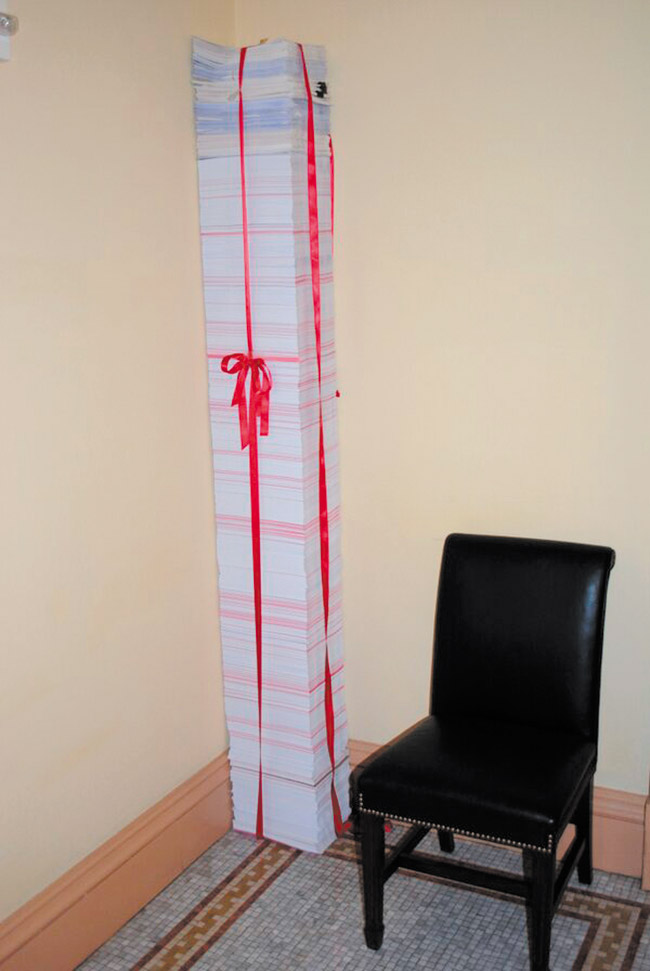
OK, cumbersome and impossible that somebody wouldn’t run afoul of some of those pages of regulation. But overall, we were on the road to something akin to national healthcare, right?
Oh, then came the exemptions. This business and that union didn’t have to comply with this or that regulation right now. But the general citizenry would have to. Oh, the sign-up system didn’t work, so you get a year’s exemption while it’s fixed.
Oh, wait, sorry, you can’t keep the health insurance plan you had, when President Obama repeatedly said you could. People we all knew had very minimal-coverage plans that could no longer be sold by participating insurers.
Oh, and you signed up and got a subsidy because of low income. Last year you got a better-paying job. Now you owe Uncle Sam a refund and you don’t have that in the bank and have to borrow money. So maybe an exemption this time? We’re up to 4 million people exempted, 3 percent of the population — half who signed up last year.
Then there are the Medicare cuts and the quality-instead-of-quantity care directive. Individual doctors are dumping Medicare patients. They and hospitals are graded on results with sick patients. Great. But you and I know many patients aren’t health-minded. They won’t change diets. They ignore critical medicines. The issue is worse in poor and immigrant neighborhoods.
Why should my doctor get penalized if I’ll do nothing to keep my blood pressure and weight under control?
If Medicare Advantage is forced to eliminate gym memberships, how does that help me to keep healthy?
Obamacare became a mess.
We healthcare progressives have to start acknowledging that in public.
We wanted national, single-payer healthcare.
Many of us have it. It’s already out there. It’s called Kaiser Permanente. We could have taxed citizens and made that a shining star system.
Not 20,000 pages. Just a slim document of your benefits. All your medical records on one computer server. Your choice of doctors.
President Obama had the right idea.
But unlike Franklin D. Roosevelt with the Social Security Act and Lyndon Johnson with the Civil Rights Act, he wimped out with Congress.
[so what now? Bob Jones?]
Saturday, February 14, 2015
Brian Williams
NBC News said Tuesday it has suspended its chief anchor and managing editor Brian Williams immediately for six months without pay, forgoing the option of firing the embattled newsman for now due to his popularity and past work at the network.
"As I'm sure you understand, this was a very hard decision," wrote NBC News President Deborah Turness in a memo distributed to staff members late Tuesday. "Certainly there will be those who disagree. But we believe this suspension is the appropriate and proportionate action."
Lester Holt, who was tapped to fill in while Williams sat out, will continue to serve as substitute anchor of NBC Nightly News. Williams took himself off the air Saturday after soldiers revealed that his account of being on a Chinook helicopter that went down during the U.S. invasion of Iraq was not true.
"We felt it would have been wrong to disregard the good work Brian has done and the special relationship he has forged with our viewers over 22 years," Turness said. "Millions of Americans have turned to him every day, and he has been an important and well-respected part of our organization."
Williams replaced Tom Brokaw in 2004 as NBC Nightly News anchor after working as a reporter at the network since the early 1990s. Mixing serious journalism with occasional appearances on late night talk shows, Williams has helped NBC Nightly News retain its lead over competitors. Despite the overall drop in evening news viewership over the years, NBC Nightly News averages about 9 million to 10 million viewers a night, edging ABC's World News Tonight and CBS Evening News.
The scandal erupted earlier this month when Williams attended a New York Rangers game with a soldier who helped guard him and other American soldiers while a convoy of military helicopters they were flying on was forced to land on a desert in Iraq in 2003.
Williams said the helicopter he was on had been hit by enemy fire and forced down. Veterans from the convoy challenged Williams' story — which he has repeated in the past — on Facebook. And the anchorman recanted the story on air Wednesday after Stars and Stripes wrote a story about their online exchange and interviewed Williams and the veterans.
***
and more?
"As I'm sure you understand, this was a very hard decision," wrote NBC News President Deborah Turness in a memo distributed to staff members late Tuesday. "Certainly there will be those who disagree. But we believe this suspension is the appropriate and proportionate action."
Lester Holt, who was tapped to fill in while Williams sat out, will continue to serve as substitute anchor of NBC Nightly News. Williams took himself off the air Saturday after soldiers revealed that his account of being on a Chinook helicopter that went down during the U.S. invasion of Iraq was not true.
"We felt it would have been wrong to disregard the good work Brian has done and the special relationship he has forged with our viewers over 22 years," Turness said. "Millions of Americans have turned to him every day, and he has been an important and well-respected part of our organization."
Williams replaced Tom Brokaw in 2004 as NBC Nightly News anchor after working as a reporter at the network since the early 1990s. Mixing serious journalism with occasional appearances on late night talk shows, Williams has helped NBC Nightly News retain its lead over competitors. Despite the overall drop in evening news viewership over the years, NBC Nightly News averages about 9 million to 10 million viewers a night, edging ABC's World News Tonight and CBS Evening News.
The scandal erupted earlier this month when Williams attended a New York Rangers game with a soldier who helped guard him and other American soldiers while a convoy of military helicopters they were flying on was forced to land on a desert in Iraq in 2003.
Williams said the helicopter he was on had been hit by enemy fire and forced down. Veterans from the convoy challenged Williams' story — which he has repeated in the past — on Facebook. And the anchorman recanted the story on air Wednesday after Stars and Stripes wrote a story about their online exchange and interviewed Williams and the veterans.
***
and more?
Monday, February 02, 2015
Kauai's electricity
While
NextEra Energy's $4.3 billion bid to buy Hawaiian Electric Industries
dominates the local energy debate, a group of Hawaii island
residents is quietly investigating another possible future for their
utility. They are
turning for inspiration to Kauai, where pioneering folks banded together
in a cooperative and bought their electric utility for $215
million in 2002 in a completely debt-financed deal.
"We had
zero equity," recalled Dennis Esaki, who runs an engineering company and
was a founding director of the nonprofit Kauai Island Utility Cooperative. "We didn't have any money. It was an amazing feat."
At first he ducked when people called about the idea of buying the electric company.
"I didn't take their phone calls," he said in an interview. "I figured they must think I got money that I don't have."
By the Numbers
Kauai Island Utility Cooperative is a not-for-profit electrical co-op owned and controlled by the members it serves.
>> $215 million: Cost of the utility when purchased in 2002
>> 33,000: Member-owners, who are its customers >> $80 million: Equity stake owned by members >> $30 million: Returned to members since 2002 >> 9: Elected board members
Source: Kauai Island Utility Cooperative
|
But he decided to join the effort. The cooperative got rolling with $200,000 fronted by a Lihue businessman, Gregg Gardiner, and the support of the National Rural Utilities Cooperative Finance Corp. which put up $2 million and financed the acquisition.
Since its
launch 12 years ago, the nonprofit Kauai Island Utility Cooperative has
returned $30 million to its members, who are its customers, money
that is left at the end of the year after expenses are met. And it has
built up more than $80 million in equity, the members' ownership
stake.
"Main
thing is, we don't have off-island owners that the profits go out to,
like an investor-owned utility," Esaki told a forum in Hilo last
month. "All of the profits, called margins in this business, stay on the
island."
The co-op
is guided by a board elected by its 33,000 ratepayers, who each get one
vote. It has aggressively pursued solar power and focused on rate
stability.
Residential
electricity cost 34.1 cents per kilowatt-hour on Kauai in January,
compared with 35.9 cents on Hawaii island, 35.1 cents on Maui and
29.5 cents on Oahu, where there are economies of scale.
Kauai's
residential electricity rates fell by 1.6 percent from 2008 to 2013
while Hawaiian Electric Co.'s rose by more than 21 percent,
according to KIUC, which crunched data from the Public Utilities
Commission.
Saturday, January 31, 2015
polarized
But the political theater that played out in the House chamber during
and after the president’s State-of-the Union spoke louder about the
country’s current politics: they’re polarized to the point of absurdity.
The president proposed “quality child care” for all. Democrats rose en masse, clapping and whooping. Republicans sat en masse, looking almost as solemn as a solemn John Lewis.
Obama called for a week of paid sick leave for every American worker. Democrats rose, Republicans sat.
Equal pay for women for equal work, the President suggested: “It’s 2015, it’s time.”
Maybe not, not in Washington’s age of virulent political polarization. Democrats rose, clapping and whooping still more. Republicans sat.
Obama asked that Congress send him a bill that would “lower the cost of community college to zero.” Again, Democrats rose, Republicans sat.
Obama gave thanks to the brave men and women who have served in America’s war and urged employers to hire vets.
At last, Democrats and Republicans all rose, all clapped and whooped lustily.
-- Dan Boylan, Midweek, January 28, 2015
The president proposed “quality child care” for all. Democrats rose en masse, clapping and whooping. Republicans sat en masse, looking almost as solemn as a solemn John Lewis.
Obama called for a week of paid sick leave for every American worker. Democrats rose, Republicans sat.
Equal pay for women for equal work, the President suggested: “It’s 2015, it’s time.”
Maybe not, not in Washington’s age of virulent political polarization. Democrats rose, clapping and whooping still more. Republicans sat.
Obama asked that Congress send him a bill that would “lower the cost of community college to zero.” Again, Democrats rose, Republicans sat.
Obama gave thanks to the brave men and women who have served in America’s war and urged employers to hire vets.
At last, Democrats and Republicans all rose, all clapped and whooped lustily.
-- Dan Boylan, Midweek, January 28, 2015
Friday, January 09, 2015
free community college?
(Reuters) - President Barack Obama wants to make two years of community college free and universally available, a proposal he said on Thursday he would flesh out in his State of the Union speech later this month.
White House officials acknowledged the plan would come with a significant price tag but declined to disclose projected costs, saying those details would come in Obama's budget on Feb. 2.
"Put simply, what I'd like to do is to see the first two years of community college free for everybody's who is willing to work for it," Obama said in a video message released by the White House.
The idea would require the Republican-controlled Congress to pass legislation so that the federal government could pay for 75 percent of tuition, with participating state governments having to pick up the rest of the tab.
"With no details or information on the cost, this seems more like a talking point than a plan," said Cory Fritz, spokesman for Speaker John Boehner, the top Republican in the House of Representatives.
If all states signed on to Obama's plan, an estimated 9 million students could benefit. A full-time community college student could save an average of $3,800 in tuition a year.
Under the proposal, students who attend at least half-time, maintain a 2.5 grade point average while in college, and make steady progress toward completing their programs would have their tuition eliminated.
White House officials acknowledged the plan would come with a significant price tag but declined to disclose projected costs, saying those details would come in Obama's budget on Feb. 2.
"Put simply, what I'd like to do is to see the first two years of community college free for everybody's who is willing to work for it," Obama said in a video message released by the White House.
The idea would require the Republican-controlled Congress to pass legislation so that the federal government could pay for 75 percent of tuition, with participating state governments having to pick up the rest of the tab.
"With no details or information on the cost, this seems more like a talking point than a plan," said Cory Fritz, spokesman for Speaker John Boehner, the top Republican in the House of Representatives.
If all states signed on to Obama's plan, an estimated 9 million students could benefit. A full-time community college student could save an average of $3,800 in tuition a year.
Under the proposal, students who attend at least half-time, maintain a 2.5 grade point average while in college, and make steady progress toward completing their programs would have their tuition eliminated.
Thursday, December 18, 2014
The Interview pulled by Sony
With theater chains defecting en masse, Sony Pictures Entertainment has pulled the planned Christmas Day release of “The Interview.”
U.S. officials have reportedly linked a massive cyber attack against Sony to North Korea, which is at the center of the Seth Rogen-James Franco comedy.
“We are deeply saddened at this brazen effort to suppress the distribution of a movie, and in the process do damage to our company, our employees, and the American public,” Sony said in a statement. “We stand by our filmmakers and their right to free expression and are extremely disappointed by this outcome.”
In announcing the decision to cancel the holiday debut, Sony also hit back at the hackers who threatened movie theaters and moviegoers and who have terrorized the studio and its employees for weeks.
“Those who attacked us stole our intellectual property, private emails and sensitive and proprietary material, and sought to destroy our spirit and our morale – all apparently to thwart the release of a movie they did not like,” the statement reads.
A few hours after making the announcent, a studio spokesman said that Sony had “no further plans” to release the comedy, either on VOD or DVD.
“The Interview” centers on a hapless television host who is recruited to assassinate North Korean dictator Kim Jong-un. The country has condemned the film and some cyber-security experts believe that it played a role in the hacking attack on the studio. North Korea has denied involvement in the attacks.
***
Washington (CNN) -- From Hollywood to Washington, the outrage is spreading over Sony Pictures' decision to cancel a movie release following a cyber attack and threats from a group of North Korea-backed hackers.
U.S. officials have reportedly linked a massive cyber attack against Sony to North Korea, which is at the center of the Seth Rogen-James Franco comedy.
“We are deeply saddened at this brazen effort to suppress the distribution of a movie, and in the process do damage to our company, our employees, and the American public,” Sony said in a statement. “We stand by our filmmakers and their right to free expression and are extremely disappointed by this outcome.”
In announcing the decision to cancel the holiday debut, Sony also hit back at the hackers who threatened movie theaters and moviegoers and who have terrorized the studio and its employees for weeks.
“Those who attacked us stole our intellectual property, private emails and sensitive and proprietary material, and sought to destroy our spirit and our morale – all apparently to thwart the release of a movie they did not like,” the statement reads.
A few hours after making the announcent, a studio spokesman said that Sony had “no further plans” to release the comedy, either on VOD or DVD.
“The Interview” centers on a hapless television host who is recruited to assassinate North Korean dictator Kim Jong-un. The country has condemned the film and some cyber-security experts believe that it played a role in the hacking attack on the studio. North Korea has denied involvement in the attacks.
***
Washington (CNN) -- From Hollywood to Washington, the outrage is spreading over Sony Pictures' decision to cancel a movie release following a cyber attack and threats from a group of North Korea-backed hackers.
Politicians urged Sony
not to back down in the face of threats tied to the release of the
controversial comedy "The Interview," and then began lashing out when
the studio made it clear it has no further plans to release the film,
which depicts an assassination plot against North Korean leader Kim Jong
Un.
Republican Rep. Ed Royce,
chairman of the House Foreign Affairs Committee, slammed Sony's
decision Thursday as a "capitulation" to the North Korean dictator and
called for the U.S. to rally the international community and severely
sanction North Korea for carrying out what he called a "cyber war."
FBI investigators tracked
the hackers who broke into Sony's servers, published private
information and threatened moviegoers back to the North Korean regime,
U.S. law enforcement officials told CNN on Wednesday. The North Korean
regime slammed the movie this summer as "terrorism and a war action."
And despite the hackers'
threat to attack movie theaters, the Department of Homeland Security has
said "there is no credible intelligence" supporting an active plot
against movie theaters. And President Barack Obama urged people to "go to the movies."
"Once you capitulate to
one dictator, does that mean that the next dictator or the next
terrorist that says you're not going to make a comedy about -- or a film
at all about ISIS," Royce said. "All of us in public life have a
responsibility right now to speak out and to say, 'No, Sony, you did the
wrong thing' and to say to Hollywood, come behind -- the other studios
should come behind Sony and offer their support."
Royce said the U.S. should get international support to sanction North Korea and cut off its access to financial institutions.
More broadly, Royce said
Sony's decision to "self-censor" undercuts U.S. efforts to promote
freedom throughout the world, including in the hermit kingdom.
"That's what's most worrisome about this decision," Royce said.
Former Republican presidential nominee Mitt Romney also urged Sony, "don't cave, fight" in a tweet on Wednesday.
***
Dr. Evil commentary
*** [12/23/14]
(Reuters) - Sony Pictures will allow "The Interview" to play in some U.S. theaters on Christmas Day, reversing its decision to pull the film, after coming under criticism from President Barack Obama and others for caving into pressure from North Korea.
The White House praised Sony's about-face, which the studio said would result in "a limited theatrical release" of the film, which stars Seth Rogen and James Franco and is about a fictional plot to assassinate North Korea leader Kim Jong Un.
Obama on Friday had called Sony's decision to pull the $44 million movie a mistake, suggesting it could set a precedent in which "some dictator some place can start imposing censorship here in the United States."
Congressional Republicans and Democrats, as well as Hollywood luminaries such as George Clooney, had also assailed the canceled release, with some accusing the studio of self-censorship. Some in Congress called for screenings on Capitol Hill or at the White House.
Franco and Rogen, who also co-directed the film, broke their silence after Sony made the announcement.
"The people have spoken! Freedom has prevailed!" Rogen said, while Franco added, "VICTORY!!!!!!! The PEOPLE and THE PRESIDENT have spoken!!!"
A national security official said U.S. authorities did not rate the threats by hackers against theatergoers as credible and that he was unaware of any plans by U.S. agencies to issue warnings of possible attacks on exhibitors screening the film.
North Korea experienced Internet problems at the weekend and a complete outage of nearly nine hours before links were largely restored on Tuesday; U.S. officials said Washington was not involved.
*** [12/24/14]
The Interview to stream today on youtube, Google Play, XBox Live.
*** [1/21/15] Coming to Netflix
***
Dr. Evil commentary
*** [12/23/14]
(Reuters) - Sony Pictures will allow "The Interview" to play in some U.S. theaters on Christmas Day, reversing its decision to pull the film, after coming under criticism from President Barack Obama and others for caving into pressure from North Korea.
The White House praised Sony's about-face, which the studio said would result in "a limited theatrical release" of the film, which stars Seth Rogen and James Franco and is about a fictional plot to assassinate North Korea leader Kim Jong Un.
Obama on Friday had called Sony's decision to pull the $44 million movie a mistake, suggesting it could set a precedent in which "some dictator some place can start imposing censorship here in the United States."
Congressional Republicans and Democrats, as well as Hollywood luminaries such as George Clooney, had also assailed the canceled release, with some accusing the studio of self-censorship. Some in Congress called for screenings on Capitol Hill or at the White House.
Franco and Rogen, who also co-directed the film, broke their silence after Sony made the announcement.
"The people have spoken! Freedom has prevailed!" Rogen said, while Franco added, "VICTORY!!!!!!! The PEOPLE and THE PRESIDENT have spoken!!!"
A national security official said U.S. authorities did not rate the threats by hackers against theatergoers as credible and that he was unaware of any plans by U.S. agencies to issue warnings of possible attacks on exhibitors screening the film.
North Korea experienced Internet problems at the weekend and a complete outage of nearly nine hours before links were largely restored on Tuesday; U.S. officials said Washington was not involved.
*** [12/24/14]
The Interview to stream today on youtube, Google Play, XBox Live.
*** [1/21/15] Coming to Netflix
Thursday, December 04, 2014
the first mile
City and rail officials eagerly showed off the transit system's first 220 feet of track on Wednesday and gave the first public view from atop the so-called elevated guideway 37 feet above farmland in East Kapolei.
"We're really seeing the project become reality," said Councilman Joey Manahan. "Today's the first of many milestones for the project."
After delays caused by a lawsuit and the failure to gain all necessary permits before construction began on the West Oahu/Farrington Highway segment, Dan Grabauskas, executive director and CEO of the Honolulu Authority for Rapid Transportation, said Wednesday that the first elevated guideway was slightly ahead of schedule.
Construction crews were supposed to have the first mile of elevated guideway ready by Wednesday for what will be the Ho‘opili Station, the third of 21 stations planned for the $5.26 billion project.
Instead, workers finished building a 1.25-mile stretch by Tuesday.
The track is laid down on the horizontal concrete guideway.
Mayor Kirk Caldwell got stuck in traffic driving from Honolulu Hale to Kapolei and said the 42-minute commute by rail from the start of the system at the Kroc Center Hawaii to Ala Moana Center will improve life for commuters.
Despite a misty, gray view from the top of the rain-soaked guideway Wednesday, Caldwell said people will be impressed when they finally see it close up.
"It's actually pretty darn nice," Caldwell said. "Most people will be pleased at how it looks. Visually, it's much narrower than the H-1 viaduct and the elevated freeway in Kahala."
"We're really seeing the project become reality," said Councilman Joey Manahan. "Today's the first of many milestones for the project."
After delays caused by a lawsuit and the failure to gain all necessary permits before construction began on the West Oahu/Farrington Highway segment, Dan Grabauskas, executive director and CEO of the Honolulu Authority for Rapid Transportation, said Wednesday that the first elevated guideway was slightly ahead of schedule.
Construction crews were supposed to have the first mile of elevated guideway ready by Wednesday for what will be the Ho‘opili Station, the third of 21 stations planned for the $5.26 billion project.
Instead, workers finished building a 1.25-mile stretch by Tuesday.
The track is laid down on the horizontal concrete guideway.
Mayor Kirk Caldwell got stuck in traffic driving from Honolulu Hale to Kapolei and said the 42-minute commute by rail from the start of the system at the Kroc Center Hawaii to Ala Moana Center will improve life for commuters.
Despite a misty, gray view from the top of the rain-soaked guideway Wednesday, Caldwell said people will be impressed when they finally see it close up.
"It's actually pretty darn nice," Caldwell said. "Most people will be pleased at how it looks. Visually, it's much narrower than the H-1 viaduct and the elevated freeway in Kahala."
Thursday, November 20, 2014
Obama's immigration plan
WASHINGTON — President Obama chose confrontation over conciliation on Thursday as he asserted the powers of the Oval Office to reshape the nation’s immigration system and dared members of next year’s Republican-controlled Congress to reverse his actions on behalf of millions of immigrants.
In an address to the nation from the East Room of the White House, Mr. Obama displayed years of frustration with congressional gridlock and a desire to frame the last years of his presidency with far-reaching executive actions. The president’s directive will shield up to five million people from deportation and allow many to work legally, but will not give them a path to citizenship.
“The actions I’m taking are not only lawful, they’re the kinds of actions taken by every single Republican president and every Democratic president for the past half century,” Mr. Obama said. “To those members of Congress who question my authority to make our immigration system work better, or question the wisdom of me acting where Congress has failed, I have one answer: Pass a bill.”
Conservative lawmakers accused the president of a gross abuse of authority and promised a legislative fight when they take full control of Congress next year. But even before Mr. Obama’s speech, Republicans appeared divided about how to stop him and unsure about how to express their anger without severely damaging their standing with Latinos.
Mr. Obama’s actions will sharpen the focus of government enforcement on criminals and foreigners who pose security threats, vastly reducing the specter that many immigrants would be detained by federal agents. High-tech workers will have an easier time coming to the United States, and security on the border will be increased.
The centerpiece of the president’s announcement is a new program for undocumented people who are the parents of United States citizens. Most of those people — estimated by officials to number slightly more than four million — would be eligible for a new legal status that would defer their deportations and allow them to work legally in the country. They must pass background checks and pay taxes, but they will get Social Security cards, officials said.
How Republicans choose to proceed in their opposition to the president’s directive will shape the final two years of Mr. Obama’s tenure and could help set the tone of the 2016 presidential campaign. Several Republicans on Thursday said they wanted to use an forthcoming spending bill and the threat of a government shutdown as leverage against Mr. Obama, while others in the party reached for ways that Congress might undercut the president’s actions by withholding money or threatening other priorities.
“If President Obama acts in defiance of the people and imposes his will on the country, Congress will act,” said Senator Mitch McConnell of Kentucky, who will become Senate majority leader in January. “We’re considering a variety of options. But make no mistake. Make no mistake. When the newly elected representatives of the people take their seats, they will act.”
Even as Republican lawyers analyzed what the White House said was the legal basis of Mr. Obama’s actions, it remained unclear how they might undo them. The agency that will carry out most of the president’s executive actions, Citizenship and Immigration Services, is funded with application fees, and does not rely on a budget vote in Congress to keep operating.
But accusations of a presidential abuse of power appear to have gained some traction in recent days, as a Wall Street Journal/NBC poll found just 38 percent support for Mr. Obama’s executive actions even as there is broad support for a path to citizenship for undocumented immigrants. In the poll, 48 percent said they oppose Mr. Obama’s actions. Even a few Democrats have expressed concern about the propriety of the president’s actions.
In an address to the nation from the East Room of the White House, Mr. Obama displayed years of frustration with congressional gridlock and a desire to frame the last years of his presidency with far-reaching executive actions. The president’s directive will shield up to five million people from deportation and allow many to work legally, but will not give them a path to citizenship.
“The actions I’m taking are not only lawful, they’re the kinds of actions taken by every single Republican president and every Democratic president for the past half century,” Mr. Obama said. “To those members of Congress who question my authority to make our immigration system work better, or question the wisdom of me acting where Congress has failed, I have one answer: Pass a bill.”
Conservative lawmakers accused the president of a gross abuse of authority and promised a legislative fight when they take full control of Congress next year. But even before Mr. Obama’s speech, Republicans appeared divided about how to stop him and unsure about how to express their anger without severely damaging their standing with Latinos.
Mr. Obama’s actions will sharpen the focus of government enforcement on criminals and foreigners who pose security threats, vastly reducing the specter that many immigrants would be detained by federal agents. High-tech workers will have an easier time coming to the United States, and security on the border will be increased.
The centerpiece of the president’s announcement is a new program for undocumented people who are the parents of United States citizens. Most of those people — estimated by officials to number slightly more than four million — would be eligible for a new legal status that would defer their deportations and allow them to work legally in the country. They must pass background checks and pay taxes, but they will get Social Security cards, officials said.
How Republicans choose to proceed in their opposition to the president’s directive will shape the final two years of Mr. Obama’s tenure and could help set the tone of the 2016 presidential campaign. Several Republicans on Thursday said they wanted to use an forthcoming spending bill and the threat of a government shutdown as leverage against Mr. Obama, while others in the party reached for ways that Congress might undercut the president’s actions by withholding money or threatening other priorities.
“If President Obama acts in defiance of the people and imposes his will on the country, Congress will act,” said Senator Mitch McConnell of Kentucky, who will become Senate majority leader in January. “We’re considering a variety of options. But make no mistake. Make no mistake. When the newly elected representatives of the people take their seats, they will act.”
Even as Republican lawyers analyzed what the White House said was the legal basis of Mr. Obama’s actions, it remained unclear how they might undo them. The agency that will carry out most of the president’s executive actions, Citizenship and Immigration Services, is funded with application fees, and does not rely on a budget vote in Congress to keep operating.
But accusations of a presidential abuse of power appear to have gained some traction in recent days, as a Wall Street Journal/NBC poll found just 38 percent support for Mr. Obama’s executive actions even as there is broad support for a path to citizenship for undocumented immigrants. In the poll, 48 percent said they oppose Mr. Obama’s actions. Even a few Democrats have expressed concern about the propriety of the president’s actions.
Tuesday, November 04, 2014
Republicans take the senate
Washington (CNN) -- A Republican tide ripped the Senate away from Democrats Tuesday, according to CNN projections, giving the GOP full control of Congress and the power to pin down President Barack Obama during his last two years in office.
The thumping win upends the balance of power between the White House and Capitol Hill only six years after Obama's Democrats swept to power and marginalized Republicans in a rush to reform health care, Wall Street and pass a huge stimulus package.
Now, it's Democrats who will take the back seat on Capitol Hill, relying mostly on the power of the filibuster to stymie Republicans and keep Obama's legacy intact.
"For too long, this administration has tried to tell the American people what is good for them and then blame somebody else when their policies didn't work out," Mitch McConnell, who is expected to become the next Senate majority leader, said in a victory speech.
House Speaker John Boehner, celebrating a widened majority, said he is "humbled by the responsibility the American people have placed with us."
"But this is not a time for celebration," he said. "It's time for government to start getting results and implementing solutions to the challenges facing our country, starting with our still-struggling economy.
Senate Majority Leader Harry Reid, who has controlled the Senate since 2007, congratulated Republicans on their victory.
"The message from voters is clear: they want us to work together," Reid said. "I look forward to working with Senator McConnell to get things done for the middle class."
But there was silence from the White House after Tuesday's results became clear. Obama will make a public statement Wednesday on an election many will see as a repudiation of his presidency, and he will host bipartisan leaders on Friday to try to chart a way forward.
***
WASHINGTON (AP) — Republicans seized control of the Senate and strengthened their hold on the House in a wave of Election Day victories Tuesday that served as a repudiation of President Barack Obama’s second-term policies and put a series of Democratic-leaning states — including Obama’s home, Illinois — under control of new Republican governors.
Senate Republican leader Mitch McConnell defeated Democrat Alison Lundergan Grimes in Kentucky, putting him in position to become the new Senate majority leader and confront Obama over his signature health care law.
Republicans took over formerly Democratic Senate seats in seven states, including GOP-leaning Arkansas, Montana, South Dakota and West Virginia. That number also included three states that figured prominently in Obama’s two victorious presidential campaigns: Iowa and Colorado, where he won twice, and North Carolina, where he won in 2008. Republicans needed a net gain of six seats in all to win back the majority for the first time since 2006.
“Thanks to you, Iowa, we are headed to Washington, and we are going to make them squeal,” declared Iowa Republican Joni Ernst, who vowed to cut pork in Washington in television ads that memorably cited her growing up castrating hogs.
In the House, Republicans were on track to meet or exceed the 246 seats they held during President Harry S. Truman’s administration more than 60 years ago.
“We are humbled by the responsibility the American people have placed with us, but this is not a time for celebration,” said House Speaker John Boehner, R-Ohio. “It’s time for government to start getting results and implementing solutions to the challenges facing our country, starting with our still-struggling economy.”
In state capitols, Republicans were poised to leave their imprint, picking up governors’ seats in reliably Democratic states like Illinois, Maryland and Massachusetts. With Congress grappling with gridlock, states have been at the forefront of efforts to raise the minimum wage and implement Obama’s health care law.
Obama’s poor approval ratings turned him into a liability for Democrats seeking re-election. The outcome offered parallels to the sixth year of Republican George W. Bush’s presidency, when Democrats won sweeping victories amid voter discontent with the wars in Iraq and Afghanistan.
*** [11/5/14]
(Reuters) - President Barack Obama and his powerful U.S. Senate adversary struck a conciliatory tone on Wednesday, but Obama's plans to proceed with new immigration rules foreshadowed a bumpy start to his relationship with a Republican-controlled Congress.
Obama and Mitch McConnell, who will become majority leader when Republicans take charge in the Senate in January, signaled they hoped to get past a previously frosty relationship to pass legislation on priorities on which they can both agree.
Republicans swept elections on Tuesday, capturing their biggest majority in the House of Representatives in more than 60 years and gaining a majority in the Senate for the first time since 2006. The election result limits what Obama can achieve without bipartisan support during his final two years in office.
"As president, I have a unique responsibility to try and make this town work," Obama, a Democrat, said at a White House news conference. "So, to everyone who voted, I want you to know that I hear you."
Obama lauded McConnell, with whom he said he hoped to share some Kentucky bourbon, and House Speaker John Boehner for expressing the wish to seek common ground after the elections. He spoke to both men earlier in the day.
McConnell said he believed Obama was interested in moving forward on trade agreements and tax reform, two issues at a standstill in Washington because of political differences.
"This gridlock and dysfunction can be ended. It can be ended by having a Senate that actually works," McConnell told reporters in his home state Kentucky.
But the words of reconciliation only went so far.
The thumping win upends the balance of power between the White House and Capitol Hill only six years after Obama's Democrats swept to power and marginalized Republicans in a rush to reform health care, Wall Street and pass a huge stimulus package.
Now, it's Democrats who will take the back seat on Capitol Hill, relying mostly on the power of the filibuster to stymie Republicans and keep Obama's legacy intact.
"For too long, this administration has tried to tell the American people what is good for them and then blame somebody else when their policies didn't work out," Mitch McConnell, who is expected to become the next Senate majority leader, said in a victory speech.
House Speaker John Boehner, celebrating a widened majority, said he is "humbled by the responsibility the American people have placed with us."
"But this is not a time for celebration," he said. "It's time for government to start getting results and implementing solutions to the challenges facing our country, starting with our still-struggling economy.
Senate Majority Leader Harry Reid, who has controlled the Senate since 2007, congratulated Republicans on their victory.
"The message from voters is clear: they want us to work together," Reid said. "I look forward to working with Senator McConnell to get things done for the middle class."
But there was silence from the White House after Tuesday's results became clear. Obama will make a public statement Wednesday on an election many will see as a repudiation of his presidency, and he will host bipartisan leaders on Friday to try to chart a way forward.
***
WASHINGTON (AP) — Republicans seized control of the Senate and strengthened their hold on the House in a wave of Election Day victories Tuesday that served as a repudiation of President Barack Obama’s second-term policies and put a series of Democratic-leaning states — including Obama’s home, Illinois — under control of new Republican governors.
Senate Republican leader Mitch McConnell defeated Democrat Alison Lundergan Grimes in Kentucky, putting him in position to become the new Senate majority leader and confront Obama over his signature health care law.
Republicans took over formerly Democratic Senate seats in seven states, including GOP-leaning Arkansas, Montana, South Dakota and West Virginia. That number also included three states that figured prominently in Obama’s two victorious presidential campaigns: Iowa and Colorado, where he won twice, and North Carolina, where he won in 2008. Republicans needed a net gain of six seats in all to win back the majority for the first time since 2006.
“Thanks to you, Iowa, we are headed to Washington, and we are going to make them squeal,” declared Iowa Republican Joni Ernst, who vowed to cut pork in Washington in television ads that memorably cited her growing up castrating hogs.
In the House, Republicans were on track to meet or exceed the 246 seats they held during President Harry S. Truman’s administration more than 60 years ago.
“We are humbled by the responsibility the American people have placed with us, but this is not a time for celebration,” said House Speaker John Boehner, R-Ohio. “It’s time for government to start getting results and implementing solutions to the challenges facing our country, starting with our still-struggling economy.”
In state capitols, Republicans were poised to leave their imprint, picking up governors’ seats in reliably Democratic states like Illinois, Maryland and Massachusetts. With Congress grappling with gridlock, states have been at the forefront of efforts to raise the minimum wage and implement Obama’s health care law.
Obama’s poor approval ratings turned him into a liability for Democrats seeking re-election. The outcome offered parallels to the sixth year of Republican George W. Bush’s presidency, when Democrats won sweeping victories amid voter discontent with the wars in Iraq and Afghanistan.
*** [11/5/14]
(Reuters) - President Barack Obama and his powerful U.S. Senate adversary struck a conciliatory tone on Wednesday, but Obama's plans to proceed with new immigration rules foreshadowed a bumpy start to his relationship with a Republican-controlled Congress.
Obama and Mitch McConnell, who will become majority leader when Republicans take charge in the Senate in January, signaled they hoped to get past a previously frosty relationship to pass legislation on priorities on which they can both agree.
Republicans swept elections on Tuesday, capturing their biggest majority in the House of Representatives in more than 60 years and gaining a majority in the Senate for the first time since 2006. The election result limits what Obama can achieve without bipartisan support during his final two years in office.
"As president, I have a unique responsibility to try and make this town work," Obama, a Democrat, said at a White House news conference. "So, to everyone who voted, I want you to know that I hear you."
Obama lauded McConnell, with whom he said he hoped to share some Kentucky bourbon, and House Speaker John Boehner for expressing the wish to seek common ground after the elections. He spoke to both men earlier in the day.
McConnell said he believed Obama was interested in moving forward on trade agreements and tax reform, two issues at a standstill in Washington because of political differences.
"This gridlock and dysfunction can be ended. It can be ended by having a Senate that actually works," McConnell told reporters in his home state Kentucky.
But the words of reconciliation only went so far.
Wednesday, October 08, 2014
$31 million in the red
The
University of Hawaii's flagship Manoa campus is facing a
multimillion-dollar tuition shortfall for a fourth straight year
as state support continues to decline while energy and personnel costs
escalate.
Manoa officials are projecting a $31 million deficit for the fiscal year that ends June 30, despite efforts to curb spending.
Manoa officials are projecting a $31 million deficit for the fiscal year that ends June 30, despite efforts to curb spending.
Interim
Manoa Chancellor Robert Bley-Vroman, who took the reins Sept. 1, said he
is actively seeking ways to cut costs but cautioned that Manoa's
debt could keep growing as the campus re-evaluates its spending
priorities.
"Our goal
is to fly level for this year, and during this year try to reconnoiter
and figure out where we're going to go in the future," Bley-Vroman
told the Honolulu Star-Advertiser on Tuesday. "The university as a
whole needs to fly level. I think we can do it. I think it will be
tough, and we may see our bank balance decline even more for a while,
but we can do it."
The overspending began in 2012, when the campus incurred a $2.6 million deficit under then-Chancellor Virginia Hinshaw.
UH-Manoa
had started that year with a $21 million surplus in tuition revenue but
was instructed by UH system administration to spend down some of
its reserves for fear that the state might view the surplus as too
healthy, said Kathy Cutshaw, Manoa's vice chancellor for
administration, finance and operations. Tuition revenues were
subsequently spent on faculty salary restorations, student
laboratory space and information technology upgrades.
The
shortfall swelled to $17 million and then $26 million in the following
two years under then-Chancellor Tom Apple. Those shortfalls were
covered by university reserves.
Utility
costs ran over budget by a combined $13 million in those years.
Among other added costs, the campus also paid out $6.4 million for 3
percent faculty salary increases that it had expected the state to
cover, and suffered a $7 million cut from the Legislature, in fiscal
2014.
Manoa's
financial crisis was the chief reason UH President David Lassner gave
when he fired Apple on July 30 with three years remaining on a
contract.
Monday, October 06, 2014
Ebola spreading
[10/6/14] MADRID » In the first known transmission of the outbreak of Ebola outside West Africa, a Spanish nurse who treated a missionary for the disease at a Madrid hospital has tested positive for the virus, Spain's health minister said Monday.
The female nurse was part of the medical team that cared for a 69-year-old Spanish priest who died Sept. 25 in a Madrid hospital designated for treating Ebola patients after he was flown home from Sierra Leone, where he served as the medical director of a hospital there treating infected Ebola patients, Health Minister Ana Mato said.
The nurse is believed to have contracted the virus from that priest, though she was also a member of the team that treated another Spanish priest who died earlier from Ebola.
More than 370 health workers in West Africa have become infected in the outbreak, and more than half of those have died. Doctors and nurses there have worked under difficult conditions, treating patients in overflowing wards, sometimes without proper protection. But even under ideal conditions, experts warn that caring for Ebola patients always involves a risk.
WHO estimates the latest Ebola outbreak has killed more than 3,400 people.
The World Health Organization on Monday night confirmed there has not been a transmission outside West Africa in the current outbreak prior to the Spanish nurse.
The female nurse was part of the medical team that cared for a 69-year-old Spanish priest who died Sept. 25 in a Madrid hospital designated for treating Ebola patients after he was flown home from Sierra Leone, where he served as the medical director of a hospital there treating infected Ebola patients, Health Minister Ana Mato said.
The nurse is believed to have contracted the virus from that priest, though she was also a member of the team that treated another Spanish priest who died earlier from Ebola.
More than 370 health workers in West Africa have become infected in the outbreak, and more than half of those have died. Doctors and nurses there have worked under difficult conditions, treating patients in overflowing wards, sometimes without proper protection. But even under ideal conditions, experts warn that caring for Ebola patients always involves a risk.
WHO estimates the latest Ebola outbreak has killed more than 3,400 people.
The World Health Organization on Monday night confirmed there has not been a transmission outside West Africa in the current outbreak prior to the Spanish nurse.
Wednesday, October 01, 2014
Hong Kong protests
The protesters aren't backing down, China isn't giving in, and the world isn't looking away.
Pro-democracy demonstrations continued in Hong Kong's streets for a sixth day on Wednesday over anger at China's refusal to allow the open selection of candidates for Hong Kong's leader in the city's first democratic election, scheduled for 2017. Hong Kong is a semi-autonomous city that is officially ruled by China.
The Chinese government is fighting social media's power of connectedness to keep mainland China in the dark, while Hong Kong protesters are harnessing it to ensure the world hears them.
Pro-democracy demonstrations continued in Hong Kong's streets for a sixth day on Wednesday over anger at China's refusal to allow the open selection of candidates for Hong Kong's leader in the city's first democratic election, scheduled for 2017. Hong Kong is a semi-autonomous city that is officially ruled by China.
The Chinese government is fighting social media's power of connectedness to keep mainland China in the dark, while Hong Kong protesters are harnessing it to ensure the world hears them.
Monday, August 25, 2014
French government dissolved
PARIS (AP) — French President Francois Hollande dissolved the government on Monday after open feuding among his Cabinet over the country's stagnant economy.
Prime Minister Manuel Valls offered up his Socialist government's resignation after accusing France's outspoken economy minister of crossing a line with his blunt criticism of the government's policies. Hollande accepted the resignation and ordered Valls to form a new government by Tuesday.
France has had effectively no economic growth this year, unemployment is hovering around 10 percent and Hollande's approval ratings are sunk in the teens. The country is under pressure from the 28-nation European Union to get its finances in order, but Economy Minister Arnaud Montebourg has questioned whether the austerity tack pressed by the EU will really kick start French growth.
Hollande's promises to cut taxes and make it easier for businesses to open and operate have stalled, in large part because of the divisions among his Socialist party.
Friday, August 15, 2014
rail transit bids exceeding budget
New construction bids show the costs to build Honolulu's rail transit system are rising sharply -- and local transit leaders remain uncertain whether they'll ultimately be able to deliver the project on budget.
This week, rail officials opened three bids to build the transit system's first nine stations. Each of those bids exceeded the project's budget for that work by more than $100 million.
The least expensive bid -- a $294.5 million proposal from Nan Inc. -- still exceeded what rail officials had budgeted by about 60 percent.
"Clearly our estimates right now are suspect," Honolulu Authority for Rapid Transportation board Vice Chairman Don Horner said Thursday.
[surprise surprise surprise]
This week, rail officials opened three bids to build the transit system's first nine stations. Each of those bids exceeded the project's budget for that work by more than $100 million.
The least expensive bid -- a $294.5 million proposal from Nan Inc. -- still exceeded what rail officials had budgeted by about 60 percent.
"Clearly our estimates right now are suspect," Honolulu Authority for Rapid Transportation board Vice Chairman Don Horner said Thursday.
[surprise surprise surprise]
HMSA is pulling out of Hawaii Health Connector
Hawaii's largest health insurer is pulling out of the small-business side of the state's troubled health exchange, leaving the Hawaii Health Connector with only one insurance company for employers to select.
Michael Gold, president of Hawaii Medical Services Association, told The Associated Press that his staff is spending too much time and money dealing with the Connector's technical problems.
"It's an ongoing expense that everyone in the state is going to have to bear, and almost everyone in the state agrees it is not the best model for Hawaii," Gold said in an interview.
The decision affects more than 300 Hawaii businesses that buy plans for 664 subscribers and independents from HMSA through the exchange. HMSA will stop offering plans to small businesses beginning January 2015. The companies will be able to finish the terms of their enrollment over the next few months, and then they can either enroll in plans directly through HMSA or choose a different plan on the exchange, likely from the only other insurer, Kaiser Permanente, Gold said.
That represents about half the Hawaii businesses purchasing insurance plans through the Connector, state Sen. Rosalyn Baker said.
"They really are dissing small businesses, and I'm appalled by that," Baker said. "They don't think about the impact. They're so used to having their way."
Tom Matsuda, interim director of the Hawaii Health Connector, said he was disappointed that HMSA decided to pull out of the small business exchange after less than a year.
The small business exchange "provides the only opportunity for small businesses to get tax credits that reduce the cost of insurance for their employees by up to 50 percent," Matsuda said in an emailed statement. "I am especially concerned about small business owners who have already qualified for the tax credits by purchasing HMSA plans through the Connector. We will do our best to help those employers."
Small businesses have to buy insurance plans through the Connector to qualify for those tax credits, said Lindsay Chambers, spokeswoman for Hawaii's Insurance Commissioner Gordon Ito, in an email.
"We will continue to seek other ways to ensure that Hawaii's small businesses are able to obtain these tax credits in accordance with federal law," Chambers said.
Gold said very few employers qualify for the tax credits.
Matsuda will work with other insurers that may want to offer plans on the exchange, he said.
The Hawaii Health Connector has been plagued with problems from its inception. Its open-enrollment period was delayed because of technical problems. Then it enrolled just 10,800 people and earned just $40,350 in its first six months, far below the $320,000 it expected. It was awarded more than $200 million in federal grants, but it couldn't get by without a $1.5 million appropriation from the Legislature. Now, Connector officials are working on reducing expenses.
While the company is pulling out of the small business side, HMSA will continue to sell plans through the Connector on the individual side, where it has nearly 5,000 customers, Gold said.
Many employers already provide insurance to most employees because of the state's Prepaid Health Care Act, which mandates coverage for workers who clock more than 20 hours per week.
But HMSA staff logged 8,000 hours dealing with problems such as data from 133 patient accounts that disappeared when it was sent from the Connector to HMSA, Gold said.
"It's an astonishing number of hours we've spent on this," Gold said. "The system still is not really working correctly."
Eric Alborg, deputy director of the Connector, said it's unfortunate that HMSA is focusing on problems and drawing attention away from the fact that "they are denying their customers tax credits." But it is true that on both sides there was a lot of time spent on fixing issues with both systems, Alborg said.
HMSA reported year-to-date loss of $8.4 million Thursday. It blamed its $30 million first-quarter loss on the Affordable Care Act and said it made up some of that loss in the second quarter.
[meanwhile that same day]
Hawaii Medical Service Association, the state's dominant health insurer, reported a $21.8 million profit in the second quarter, compared with losing $2.3 million in the same period a year ago.
The health plan collected $730.4 million in premiums, up 8.3 percent from $674.2 million, and spent $652.3 million, a 2.9 percent increase from $634.2 million in the second quarter of 2013. Administrative expenses totaled $54.8 million, down 10.2 percent from the $61 million it spent a year earlier.
HMSA's $17 million operating gain was augmented by $4.8 million in investment income, resulting in earnings of $21.8 million. A year earlier, investment gains of $15.4 million reduced the insurer's $21 million operating loss to a $2.3 million deficit.
At the end of the second quarter, HMSA's membership grew to 730,745, up from 719,977, and its reserve stood at $391.7 million, or $536 per member per month.
In July, HMSA boosted rates by 8.9 percent for 110,000 consumers and 8,500 small businesses. HMSA had originally sought a rate hike of 13.1 percent, but that was lowered by the state Insurance Division, which regulates health plan rates.
"It's a struggle to live in Hawaii and make ends meet for businesses and individuals," Steve Van Ribbink, HMSA's chief financial officer, said in a statement. "When we set premiums, we put every effort into making sure we collect only what's necessary to cover the cost of making sure our members' health care needs are met."
Beyond the written statement, Van Ribbink was not available to answer questions about the quarterly earnings.
HMSA said the second-quarter gain helped the company recoup some of its losses in the first quarter, which totaled $30.1 million. It attributed much of the first-quarter loss to $46.1 million in fees related to the Affordable Care Act, also known as Obamacare.
While the ACA fees will be paid to the federal government in September, all insurers, including HMSA, were required to set money aside and record it in financial reports Jan. 1, Van Ribbink said.
"The gain we reported for the second quarter can be attributed in part to collecting ACA fees from our members in the second quarter and recognizing those fees as revenue without recording the related expense, since the related expense was previously recorded on Jan. 1," Van Ribbink said.
The not-for-profit mutual benefit society will pay $65.4 million in ACA fees this year, with the remaining Obamacare fees -- about $19.3 million -- to be expensed throughout the year.
Michael Gold, president of Hawaii Medical Services Association, told The Associated Press that his staff is spending too much time and money dealing with the Connector's technical problems.
"It's an ongoing expense that everyone in the state is going to have to bear, and almost everyone in the state agrees it is not the best model for Hawaii," Gold said in an interview.
The decision affects more than 300 Hawaii businesses that buy plans for 664 subscribers and independents from HMSA through the exchange. HMSA will stop offering plans to small businesses beginning January 2015. The companies will be able to finish the terms of their enrollment over the next few months, and then they can either enroll in plans directly through HMSA or choose a different plan on the exchange, likely from the only other insurer, Kaiser Permanente, Gold said.
That represents about half the Hawaii businesses purchasing insurance plans through the Connector, state Sen. Rosalyn Baker said.
"They really are dissing small businesses, and I'm appalled by that," Baker said. "They don't think about the impact. They're so used to having their way."
Tom Matsuda, interim director of the Hawaii Health Connector, said he was disappointed that HMSA decided to pull out of the small business exchange after less than a year.
The small business exchange "provides the only opportunity for small businesses to get tax credits that reduce the cost of insurance for their employees by up to 50 percent," Matsuda said in an emailed statement. "I am especially concerned about small business owners who have already qualified for the tax credits by purchasing HMSA plans through the Connector. We will do our best to help those employers."
Small businesses have to buy insurance plans through the Connector to qualify for those tax credits, said Lindsay Chambers, spokeswoman for Hawaii's Insurance Commissioner Gordon Ito, in an email.
"We will continue to seek other ways to ensure that Hawaii's small businesses are able to obtain these tax credits in accordance with federal law," Chambers said.
Gold said very few employers qualify for the tax credits.
Matsuda will work with other insurers that may want to offer plans on the exchange, he said.
The Hawaii Health Connector has been plagued with problems from its inception. Its open-enrollment period was delayed because of technical problems. Then it enrolled just 10,800 people and earned just $40,350 in its first six months, far below the $320,000 it expected. It was awarded more than $200 million in federal grants, but it couldn't get by without a $1.5 million appropriation from the Legislature. Now, Connector officials are working on reducing expenses.
While the company is pulling out of the small business side, HMSA will continue to sell plans through the Connector on the individual side, where it has nearly 5,000 customers, Gold said.
Many employers already provide insurance to most employees because of the state's Prepaid Health Care Act, which mandates coverage for workers who clock more than 20 hours per week.
But HMSA staff logged 8,000 hours dealing with problems such as data from 133 patient accounts that disappeared when it was sent from the Connector to HMSA, Gold said.
"It's an astonishing number of hours we've spent on this," Gold said. "The system still is not really working correctly."
Eric Alborg, deputy director of the Connector, said it's unfortunate that HMSA is focusing on problems and drawing attention away from the fact that "they are denying their customers tax credits." But it is true that on both sides there was a lot of time spent on fixing issues with both systems, Alborg said.
HMSA reported year-to-date loss of $8.4 million Thursday. It blamed its $30 million first-quarter loss on the Affordable Care Act and said it made up some of that loss in the second quarter.
[meanwhile that same day]
Hawaii Medical Service Association, the state's dominant health insurer, reported a $21.8 million profit in the second quarter, compared with losing $2.3 million in the same period a year ago.
The health plan collected $730.4 million in premiums, up 8.3 percent from $674.2 million, and spent $652.3 million, a 2.9 percent increase from $634.2 million in the second quarter of 2013. Administrative expenses totaled $54.8 million, down 10.2 percent from the $61 million it spent a year earlier.
HMSA's $17 million operating gain was augmented by $4.8 million in investment income, resulting in earnings of $21.8 million. A year earlier, investment gains of $15.4 million reduced the insurer's $21 million operating loss to a $2.3 million deficit.
At the end of the second quarter, HMSA's membership grew to 730,745, up from 719,977, and its reserve stood at $391.7 million, or $536 per member per month.
In July, HMSA boosted rates by 8.9 percent for 110,000 consumers and 8,500 small businesses. HMSA had originally sought a rate hike of 13.1 percent, but that was lowered by the state Insurance Division, which regulates health plan rates.
"It's a struggle to live in Hawaii and make ends meet for businesses and individuals," Steve Van Ribbink, HMSA's chief financial officer, said in a statement. "When we set premiums, we put every effort into making sure we collect only what's necessary to cover the cost of making sure our members' health care needs are met."
Beyond the written statement, Van Ribbink was not available to answer questions about the quarterly earnings.
HMSA said the second-quarter gain helped the company recoup some of its losses in the first quarter, which totaled $30.1 million. It attributed much of the first-quarter loss to $46.1 million in fees related to the Affordable Care Act, also known as Obamacare.
While the ACA fees will be paid to the federal government in September, all insurers, including HMSA, were required to set money aside and record it in financial reports Jan. 1, Van Ribbink said.
"The gain we reported for the second quarter can be attributed in part to collecting ACA fees from our members in the second quarter and recognizing those fees as revenue without recording the related expense, since the related expense was previously recorded on Jan. 1," Van Ribbink said.
The not-for-profit mutual benefit society will pay $65.4 million in ACA fees this year, with the remaining Obamacare fees -- about $19.3 million -- to be expensed throughout the year.
Friday, August 08, 2014
Obama authorizes airstrikes in Iraq
Washington (CNN) -- U.S. President Barack Obama said Thursday that he's authorized "targeted airstrikes" in Iraq to protect American personnel and help Iraqi forces.
"We do whatever is necessary to protect our people," Obama said. "We support our allies when they're in danger."
A key concern for U.S. officials: dozens of American consular staff and military advisers working with the Iraqi military in Irbil, the largest city in Iraq's Kurdish region.
Obama said Thursday he'd directed the military to take targeted strikes against Islamist militants "should they move towards the city."
Rapid developments on the ground, where a humanitarian crisis is emerging with minority groups facing possible slaughter by Sunni Muslim extremists, have set the stage for an increasingly dire situation.
Thousands of families from the Yazidi minority are reportedly trapped in the mountains without food, water or medical care after fleeing the rampaging fighters of the Islamic State, also known as Islamic State of Iraq and Syria or ISIS.
Throngs of refugees, many of them Iraqi Christians, are on the run -- their largest city, Qaraqosh, now occupied by fighters who gave them an ultimatum, "Convert to Islam or die."
Obama also said he'd authorized targeted airstrikes "if necessary" to help Iraqi forces protect civilians trapped on the mountain.
"When we face a situation like we do on that mountain with innocent people facing the prospect of violence on a horrific scale, when we have a mandate to help, in this case a request from the Iraqi government, and when we have the unique capabilities to help avert a massacre, then I believe the United States of America cannot turn a blind eye," Obama said. "We can act, carefully and responsibly to prevent a potential act of genocide."
The potential escalation of U.S. military involvement comes two years after Obama ended the Iraq war and brought home American forces.
"We do whatever is necessary to protect our people," Obama said. "We support our allies when they're in danger."
A key concern for U.S. officials: dozens of American consular staff and military advisers working with the Iraqi military in Irbil, the largest city in Iraq's Kurdish region.
Obama said Thursday he'd directed the military to take targeted strikes against Islamist militants "should they move towards the city."
Rapid developments on the ground, where a humanitarian crisis is emerging with minority groups facing possible slaughter by Sunni Muslim extremists, have set the stage for an increasingly dire situation.
Thousands of families from the Yazidi minority are reportedly trapped in the mountains without food, water or medical care after fleeing the rampaging fighters of the Islamic State, also known as Islamic State of Iraq and Syria or ISIS.
Throngs of refugees, many of them Iraqi Christians, are on the run -- their largest city, Qaraqosh, now occupied by fighters who gave them an ultimatum, "Convert to Islam or die."
Obama also said he'd authorized targeted airstrikes "if necessary" to help Iraqi forces protect civilians trapped on the mountain.
"When we face a situation like we do on that mountain with innocent people facing the prospect of violence on a horrific scale, when we have a mandate to help, in this case a request from the Iraqi government, and when we have the unique capabilities to help avert a massacre, then I believe the United States of America cannot turn a blind eye," Obama said. "We can act, carefully and responsibly to prevent a potential act of genocide."
The potential escalation of U.S. military involvement comes two years after Obama ended the Iraq war and brought home American forces.
Iselle and Julio
[8/10/14] Julio moves north
[8/9/14] The one-two hurricane punch that was supposed to hit Hawaii is looking more like a jab and a missed left hook.
[8/8/14] At the same time Iselle is wreaking havoc on the Hawaiian Islands, Hurricane Julio continues to churn in its wake, offering a real threat to deliver a rare double whammy of destruction on the state.
[8/9/14] The one-two hurricane punch that was supposed to hit Hawaii is looking more like a jab and a missed left hook.
After Hawaii cleared Tropical Storm Iselle largely without deterring
sunbathers and surfers, the state looked toward Hurricane Julio, which
was expected to pass roughly 160 miles northeast of the islands at its
closest point early Sunday.
While prospects for Julio could quickly change, the storms appear to
have been more a scare for Hawaii than a significant threat.
[8/8/14] At the same time Iselle is wreaking havoc on the Hawaiian Islands, Hurricane Julio continues to churn in its wake, offering a real threat to deliver a rare double whammy of destruction on the state.
Julio
strengthened to a Category 3 hurricane Thursday with 115 mph winds and
traveling westerly at 16 mph more than 1,000 miles to the east of
Hawaii.
It's
moving in roughly the same path as Iselle, although the projected track
would take it just north of the islands and arriving near Hawaii
island Sunday and the rest of the chain Monday.
[8/8/14] HILO » The
power supply and the geothermal plant in Puna proved to be among the
first casualties of Iselle as it bore down on the Big Island
Thursday night.
More than 18,000 people were without power, a Hawai‘i Electric Light Co. spokeswoman said.
After
spending nearly all day as a Category 1 hurricane, Iselle weakened into a
tropical storm, packing 70 mph winds, by 11 p.m., when its center
was about 50 miles south of Hilo, according to the Central Pacific
Hurricane Center.
No
injuries were reported, but Iselle knocked out power, forced roads to
close and sent more than 800 people and pets into evacuation centers
to ride out the first hurricane to touch island shores since Iniki
devastated Kauai in 1992.
Iselle, a
Category 1 hurricane, triggered heavy rain, thundershowers, winds and
high surf that forced repair crews to head out into the night
Thursday to restore power from Puna through Hilo.
"So much wind, so much rain," Mayor Billy Kenoi said Thursday night at the Hawaii County Civil Defense headquarters in Hilo.
[8/7/14] After
Hurricane Iselle surprised forecasters Wednesday by gaining strength, it
may now become the first hurricane to make landfall in Hawaii
since Iniki 22 years ago.
The storm
was on a course to slam into Hawaii island Thursday and unleash
sustained winds of 60 to 70 mph with gusts to 95 mph, forecasters
said.
But
projections show the storm should weaken as it moves west and south of
Maui County Thursday night and Oahu and Kauai on Friday, packing 35-
to 45-plus mph winds with locally higher gusts.
"The
volcanoes of the Big Island will do a number on the system," said Mike
Cantin, National Weather Service meteorologist. "So what it looks
like on the other side — that's something we will be looking at
closely."
All of
the islands, he said, should prepare for 5 to 8 inches of rain and up to
a foot of rain in some locations, especially in windward areas,
with flash flooding a possibility.
"People need to understand this is a large system and the impacts will reach far from the center," he said.
Making
matters worse, another storm, Julio, grew into a Category 1 hurricane
late Tuesday and is following in the wake of Iselle a couple of
days to the rear. But forecasters expect it to weaken and become a
tropical storm when it nears Hawaii Sunday or later.
Tuesday, August 05, 2014
Obamacare: a tale of two Americas
WASHINGTON (AP) - President Barack Obama's health care law has become a tale of two Americas.
States that fully embraced the law's coverage expansion are experiencing a significant drop in the number of uninsured residents, according to a major new survey released Tuesday. States whose leaders still object to "Obamacare" are seeing much less change.
The Gallup-Healthways Well-Being Index found an overall drop of 4 percentage points in the share of uninsured residents for states accepting the law's core coverage provisions. Those are states that expanded their Medicaid programs and also built or took an active role managing new online insurance markets.
The drop was about half that level — 2.2 percentage points — in states that took neither of those steps, or just one of them.
"Those states that implement the law's major mechanisms are seeing a significantly greater decline in their uninsured rates," said Dan Witters, research director for the poll.
Medicaid expansion mainly helps low-income uninsured adults in states accepting it. Insurance exchanges operate in every state, offering taxpayer-subsidized private coverage to people who have no health plan on the job.
Leading the nation were two southern states where the law has found political support. Arkansas saw a drop of about 10 percentage points in its share of uninsured residents, from 22.5 percent in 2013, to 12.4 percent by the middle of this year. Kentucky experienced a drop of nearly 9 percentage points, from 20.4 percent of its residents uninsured in 2013, to 11.9 percent.
States that fully embraced the law's coverage expansion are experiencing a significant drop in the number of uninsured residents, according to a major new survey released Tuesday. States whose leaders still object to "Obamacare" are seeing much less change.
The Gallup-Healthways Well-Being Index found an overall drop of 4 percentage points in the share of uninsured residents for states accepting the law's core coverage provisions. Those are states that expanded their Medicaid programs and also built or took an active role managing new online insurance markets.
The drop was about half that level — 2.2 percentage points — in states that took neither of those steps, or just one of them.
"Those states that implement the law's major mechanisms are seeing a significantly greater decline in their uninsured rates," said Dan Witters, research director for the poll.
Medicaid expansion mainly helps low-income uninsured adults in states accepting it. Insurance exchanges operate in every state, offering taxpayer-subsidized private coverage to people who have no health plan on the job.
Leading the nation were two southern states where the law has found political support. Arkansas saw a drop of about 10 percentage points in its share of uninsured residents, from 22.5 percent in 2013, to 12.4 percent by the middle of this year. Kentucky experienced a drop of nearly 9 percentage points, from 20.4 percent of its residents uninsured in 2013, to 11.9 percent.
Monday, August 04, 2014
Israeli shelling of Gaza
[8/5/14] (CNN) -- Withdrawing its ground forces from Gaza Tuesday for a three-day cease-fire with Hamas, Israel announced that its central goal was achieved.
"Mission accomplished," the Israel Defense Forces (IDF) said on Twitter. "We have dismantled the underground terror network built by Hamas to infiltrate and attack Israel." The military said 32 tunnels were destroyed in the four-week conflict.
The declaration came amid suspicions on both sides over whether the 72-hour humanitarian cease-fire will hold.
Nearly 1,900 Palestinians have been killed in Gaza during the conflict, according to the Palestinian Health Ministry. It's unclear how many were militants. The United Nations estimates that about 70% of the dead were civilians. But the IDF says about 900 militants were killed. It did not provide a breakdown of the victims by age or gender.
Israeli officials have said 64 Israeli soldiers and three civilians in Israel have died.
Israel is implementing the Egyptian-brokered truce, which took effect Tuesday morning, while maintaining "defensive positions" outside Gaza, the IDF said.
[8/4/14] Washington (AFP) - The United States lashed out at the "disgraceful" shelling of a United Nations school packed with refugees in Gaza on Sunday, demanding Israel do more to avoid civilian casualties.
In one of the most strongly-worded statements yet from Washington since the conflict began nearly a month ago, State Department spokeswoman Jen Psaki said the United States was "appalled" by the attack on the school in Rafah.
At least 10 people were killed in the shelling, the third time in 10 days that a UN school has been hit in fighting amid growing international outrage over the civilian death toll in the nearly month-old conflict.
Thousands of Palestinians had sought refuge at the school from fierce fighting between Israeli forces and the Palestinian enclave's Islamist rulers Hamas.
"The United States is appalled by today’s disgraceful shelling outside an UNRWA school in Rafah sheltering some 3,000 displaced persons, in which at least 10 more Palestinian civilians were tragically killed," Psaki said in a statement.
"We once again stress that Israel must do more to meet its own standards and avoid civilian casualties."
[7/20/14] GAZA/JERUSALEM (Reuters) - At least 40 Palestinians were killed on Sunday by Israeli shelling in a Gaza neighborhood, where bodies were strewn in the street and thousands fled toward a hospital packed with wounded, witnesses and health officials said.
"Mission accomplished," the Israel Defense Forces (IDF) said on Twitter. "We have dismantled the underground terror network built by Hamas to infiltrate and attack Israel." The military said 32 tunnels were destroyed in the four-week conflict.
The declaration came amid suspicions on both sides over whether the 72-hour humanitarian cease-fire will hold.
Nearly 1,900 Palestinians have been killed in Gaza during the conflict, according to the Palestinian Health Ministry. It's unclear how many were militants. The United Nations estimates that about 70% of the dead were civilians. But the IDF says about 900 militants were killed. It did not provide a breakdown of the victims by age or gender.
Israeli officials have said 64 Israeli soldiers and three civilians in Israel have died.
Israel is implementing the Egyptian-brokered truce, which took effect Tuesday morning, while maintaining "defensive positions" outside Gaza, the IDF said.
[8/4/14] Washington (AFP) - The United States lashed out at the "disgraceful" shelling of a United Nations school packed with refugees in Gaza on Sunday, demanding Israel do more to avoid civilian casualties.
In one of the most strongly-worded statements yet from Washington since the conflict began nearly a month ago, State Department spokeswoman Jen Psaki said the United States was "appalled" by the attack on the school in Rafah.
At least 10 people were killed in the shelling, the third time in 10 days that a UN school has been hit in fighting amid growing international outrage over the civilian death toll in the nearly month-old conflict.
Thousands of Palestinians had sought refuge at the school from fierce fighting between Israeli forces and the Palestinian enclave's Islamist rulers Hamas.
"The United States is appalled by today’s disgraceful shelling outside an UNRWA school in Rafah sheltering some 3,000 displaced persons, in which at least 10 more Palestinian civilians were tragically killed," Psaki said in a statement.
"We once again stress that Israel must do more to meet its own standards and avoid civilian casualties."
[7/20/14] GAZA/JERUSALEM (Reuters) - At least 40 Palestinians were killed on Sunday by Israeli shelling in a Gaza neighborhood, where bodies were strewn in the street and thousands fled toward a hospital packed with wounded, witnesses and health officials said.
The mass casualties in the Shejaia district in northeast Gaza were the heaviest since Israel launched its offensive on the Palestinian territory on July 8 after cross-border rocket strikes by militants intensified.
Anguished cries of "Did you see Ahmed?" "Did you see my wife?" echoed through the courtyard of Gaza's Shifa hospital, where panicked residents of Shejaia gathered in family groups, while inside bodies and wounded lay on blood-stained floors.
Video given to Reuters by a local showed at least a dozen mangled corpses, including three children, lying in the rubble-filled streets.
At the hospital, about 3 km (2 miles away), elderly men said the Israeli attack was the fiercest they had seen since the 1967 Middle East war, when Israel captured Gaza.
"Forty martyrs have been counted so far ... medics are searching for possibly more casualties," Naser Tattar, Shifa hospital's director, told Reuters. He said some 400 people were wounded in the Israeli attack.
Thousands fled Shejaia, some by foot and others piling into the backs of trucks and sitting on the hoods of cars filled with families trying to get away.
Asked about the attack, an Israeli military spokeswoman said: "Two days ago, residents of Shejaia received recorded messages to evacuate the area in order to protect their lives."
There were no signs of a diplomatic breakthrough toward a ceasefire, and militants kept up their rocket fire on Israel. Sirens sounded in southern Israeli towns and in the Tel Aviv metropolitan area. There were no reports of casualties.
Hamas, the dominant armed group in the Gaza Strip, had urged people across the territory not to heed the Israeli warnings and abandon their homes.
As the tank shells began to land, Shejaia residents called radio stations pleading for evacuation. An air strike on the Shejaia home of Khalil al-Hayya, a senior Hamas official, killed his son, daughter-in-law and two grandchildren, hospital officials said.
Palestinian President Mahmoud Abbas condemned "the new massacre committed by the Israeli government in Shejaia", a spokesman for the Western-backed leader said.
Israel, which has accused Hamas of using civilians as human shields by launching rockets from residential areas, sent ground forces into the Gaza Strip on Thursday after 10 days of air, naval and artillery barrages failed to stop the salvoes.
The military said it beefed up its presence on Sunday, with a focus on destroying missile stockpiles and a vast tunnel system Hamas built along the frontier that crosses into Israel.
Gaza's Health Ministry officials said at least 370 Palestinians, many of them civilians, have been killed in the 13-day conflict and about 2,600 have been wounded. On Israel's side, two civilians were killed by cross-border fire and five soldiers died as fighting occurred at close quarters.
Subscribe to:
Posts (Atom)