[7/15/15] The landmark Iran nuclear deal poses a threat to both Israel and the
United States, Israeli Prime Minister Benjamin Netanyahu told NBC News'
Lester Holt on Wednesday.
"We think this is not only a threat to us. We
think this is a threat to you as well," Netanyahu said, a day after Iran
and six world powers, including the U.S., reached the historic
agreement. "Iran has killed more Americans than anyone other than al
Qaeda."
"They're going to get hundreds of billions of dollars to fuel their terror and military machine," he added.
***
VIENNA — Iran and world powers capped a decade-long dispute by
reaching a historic deal early Tuesday for Tehran to curb its nuclear program in exchange for the easing of economic sanctions.
The Islamic republic has been negotiating with
the U.S., Britain, France, Germany, Russia and China for years, with
diplomats most recently extending numerous deadlines in hopes of
arriving at a workable and comprehensive plan.
President Barack Obama said the deal with Tehran ensures that "every pathway to a nuclear weapon" had been cut off.
"We have stopped the spread of nuclear weapons in this region," he said in an early-morning statement which — in a rare move — was carried on Iranian television.
His remarks appeared aimed at reassuring close U.S. allies like Israel and Saudi Arabia, who have vehemently opposed a deal and insisted Iran cannot be trusted with a nuclear program of any kind.
Obama said that if Iran violates the terms of the agreement, sanctions will be snapped back into place.
The deal is "not built on trust," he explained. "It is built on verification."
The president spoke after Iran's Foreign Minister Javad Zarif called
the agreement a "historic moment" and a "win-win solution" with the
potential to usher in a "new chapter of hope" in relations.
"We are reaching an agreement that is not
perfect for anybody but it is what we could accomplish and it is an
important achievement for all of us," he said early Tuesday. "Today
could have been the end of hope on this issue but now we are starting a
new chapter of hope."
Both Obama and Secretary of State John Kerry billed the agreement as critical to averting broader conflict, with Kerry telling NBC News that "Israel is safer" as a result — but Israeli officials insisted it would have the opposite effect.
Prime Minister Benjamin Netanyahu said the deal
gave Iran a "sure path to nuclear weapons" while Science Minister Danny
Danon called the accord "dangerous for the entire free world."
However, the EU's chief negotiator stressed the terms were "balanced" and respected the interests of "all sides."
"It's not only a deal," Federica Mogherini said at a press conference formally announcing the accord. "It's a good deal."
The comprehensive agreement — which runs more than 80 pages — was clinched after marathon overnight negotiations in Vienna.
It involves limiting Iran's nuclear production for 10 years and
Tehran's access to nuclear fuel and equipment for 15 years in return for
hundreds of millions of dollars in sanctions relief. However, the
sanctions would not be lifted until Iran proves to the International
Atomic Energy Agency that it has met its obligations under the terms of
the deal.
The agreement includes the provision of a "snap
back" mechanism that could lead to the reinstatement of sanctions within
65 days if Iran violates the terms of the deal, according to officials.
The deal still faces a vote in Congress,
although it is unclear whether Republicans and some Democrats who
object to the deal will actually be able to override the decision — and
Obama threatened Tuesday to veto any attempt to reject the accord.
Washington was already abuzz even before Obama spoke, with Republican Sen. Ben Sasse saying the administration had "just lit the fuse for a nuclear arms race in the Middle East."
"We all know Iran's neighbors will not sit idly
as the world's largest state-sponsor of terror becomes a
nuclear-threshold state," Sasse said in a statement.
Democratic Sen. Ben Cardin, ranking member of the Foreign Relations
Committee, said Congress has an "obligation to vigorously and
judiciously review the deal."
"It is in America's national security interest
that Iran is blocked from ever having a nuclear weapon," he said in a
statement. "Negotiators have spent painstaking time and untold effort
working on this accord. Congress in turn must fulfill its oversight
responsibilities."
Tuesday, July 14, 2015

Monday, June 29, 2015
U.S. Supreme Court rules same-sex marriage legal
The Supreme Court
ruled on Friday that the U.S. Constitution provides same-sex couples
the right to marry, handing a historic triumph to the American gay
rights movement.
The court ruled 5-4 that the Constitution's guarantees of due process and equal protection under the law mean that states cannot ban same-sex marriages. With the landmark ruling, gay marriage becomes legal in all 50 states.
Immediately after the decision, same-sex couples in many of the states where gay marriage had been banned headed to county clerks' offices for marriage licenses as officials in several states said they would respect the ruling.
President Barack Obama, appearing in the White House Rose Garden, hailed the ruling as a milestone in American justice that arrived "like a thunderbolt."
"This ruling is a victory for America," said Obama, the first sitting president to support gay marriage. "This decision affirms what millions of Americans already believe in their hearts. When all Americans are treated as equal, we are all more free."
As night fell, the White House was lit in rainbow colors - a symbol of gay pride - to mark the high court's decision.
Thursday, June 25, 2015
Obamacare nationwide subsidies upheld
WASHINGTON (AP) — The Supreme Court on Thursday upheld the nationwide tax subsidies underpinning President Barack Obama's health care
overhaul, rejecting a major challenge to the landmark law in a ruling
that preserves health insurance for millions of Americans.
The justices said in a 6-3 ruling that the subsidies that 8.7 million people currently receive to make insurance affordable do not depend on where they live, as opponents contended.
The outcome was the second major victory for Obama in politically charged Supreme Court tests of his most significant domestic achievement. And it came the same day the court gave him an unexpected victory by preserving a key tool the administration uses to fight housing bias.
Obama greeted news of the decision by declaring the health care law "is here to stay." He said the law is no longer about politics, but the benefits millions of people are receiving.
Declining to concede, House Speaker John Boehner of Ohio said Republicans, who have voted more than 50 times to undo the law, will "continue our efforts to repeal the law and replace it with patient-centered solutions that meet the needs of seniors, small business owners, and middle-class families."
At the court, Chief Justice John Roberts again voted with his liberal colleagues in support of the law. Roberts also was the key vote to uphold it in 2012. Justice Anthony Kennedy, a dissenter in 2012, was part of the majority on Thursday.
"Congress passed the Affordable Care Act to improve health insurance markets, not to destroy them," Roberts declared in the majority opinion.
Limiting the subsidies only to individuals in states with their own exchanges could well push insurance markets in the other states "into a death spiral," Roberts wrote.
Justice Antonin Scalia, in a dissent he summarized from the bench, strongly disagreed. "We should start calling this law SCOTUScare," he said, using an acronym for the Supreme Court and suggesting his colleagues' ownership by virtue of their twice stepping in to save the law from what he considered worthy challenges.
His comment drew a smile from Roberts, his seatmate and the object of Scala's ire.
Scalia said that Roberts' 2012 decision that upheld the law and his opinion on Thursday "will publish forever the discouraging truth that the Supreme Court of the United States favors some laws over others, and is prepared to do whatever it takes to uphold and assist its favorites."
Justices Samuel Alito and Clarence Thomas joined the dissent, as they did in 2012.
Nationally, 10.2 million people have signed up for health insurance under the Obama health overhaul. That includes the 8.7 million people who are receiving an average subsidy of $272 a month to help pay their insurance premiums.
Of those receiving subsidies, 6.4 million were at risk of losing that aid because they live in states that did not set up their own health insurance exchanges.
The health insurance industry breathed a big sigh of relief, and a national organization representing state regulators from both political parties said the court's decision will mean stable markets for consumers.
Shares of publicly traded hospital operators including HCA Holdings Inc. and Tenet Healthcare Corp. soared after the ruling relieved those companies of the prospect of having to deal with an influx of uninsured people. Investors had worried that many patients would drop their coverage if they no longer had tax credits to help pay.
The challenge devised by die-hard opponents of the law relied on four words — "established by the state" — in the more than 900-page law.
The law's opponents argued that the vast majority of people who now get help paying for their insurance premiums are ineligible for their federal tax credits. That is because roughly three dozen states opted against creating their own health insurance marketplaces, or exchanges, and instead rely on the federal healthcare.gov to help people find coverage if they don't get insurance through their jobs or the government.
In the challengers' view, the phrase "established by the state" demonstrated that subsidies were to be available only to people in states that set up their own exchanges.
The administration, congressional Democrats and 22 states responded that it would make no sense to construct the law the way its opponents suggested. The idea behind the law's structure was to decrease the number of uninsured. The law prevents insurers from denying coverage because of "pre-existing" health conditions. It requires almost everyone to be insured and provides financial help to consumers who otherwise would spend too much of their paycheck on their premiums.
Tuesday, June 23, 2015
Kenny's Restaurant closing
Kenny's Restaurant, an institution in Kalihi for some 49 years, will serve its last meal July 5.
Second-generation owner and operator John Fujieki, 66, said "the Lord is telling me to ‘take care of your health,'" he told the Honolulu Star-Advertiser, after suffering health problems earlier this year.
The family's third generation is involved in the business but not ready to take over.
The family remains part of a hui of entities that owns the shopping center on land leased from Kamehameha Schools.
In recent years Fujieki's family sold its interests in Star Markets, another business his father and uncles started in 1954. His grandparents were the first Hawaii merchants in the family, starting the business with Kakaako Meat Market in 1929.
Generations of kamaaina fondly recall the old Kenny's television commercial, which started with a warbly piano instrumental and ended with vocalists singing "Kenny's, at the Kam Shopping Center in Kalihi."
A later commercial starred local celebrity fisherman and "Fishing Tales" host Mike Sakamoto touting Kenny's fresh-catch selections.
The restaurant is known for its traditional chop suey mix of local favorites from teri burgers and traditional burgers to oxtail soup and prime rib, and so much more, for breakfast, lunch and dinner.
"They have the best mahimahi ever," said public relations practitioner Mona Wood-Sword, principal of Ikaika Communications LLC. "They use egg batter. It's not like one of those deep-fried things," she said.
Wood-Sword has been going to Kenny's since she was "a little girl," she said.
"Every Sunday after church, that's where we would go for breakfast. … Mrs. Takai was our waitress for 30 years. I literally grew up with it," she said.
"When Kenny's Burger House closed down, we were so sad, but we thought at least the restaurant is still here," she said.
Her childhood habit carried into her professional life as an adult, often meeting with clients at the restaurant.
"We're already in mourning now, but we're all planning to get together and eat here at least two or three more times, just to get our fill," Wood-Sword said.
The restaurant and former hamburger place, also at the shopping center, were established by Fujieki's father, John Sr., who was the majority owner, along with partners Herbert Souza and Kenny Kaneshiro. The restaurants were named after Kaneshiro.
The menu was adjusted over the years, keeping many of the favorites but adding lighter, more health-conscious fare. The changes had a positive effect on the restaurant's bottom line, "but I don't know, we still have to close," Fujieki said.
The closure decision affects both the flagship restaurant in Kamehameha Shopping Center, open since 1966, and the Kenny's Express quick-service operation in the Royal Hawaiian Center food court, opened in 2008.
The closures affect some 48 employees at the Kalihi restaurant and nine in Waikiki.
Altres, the company that provides Kenny's with human resources services, will be helping employees find new jobs or make other transitions, he said.
Employees were told about the planned closure some three months ago, Fujieki said. In recent days workers began sharing the news with customers, including Wood-Sword.
"I just wish somebody else would take it over … and keep it the same, because who wants a new thing? We want Kenny's," she said with a laugh.
Thursday, June 18, 2015
Shooting at Charleston church
CHARLESTON, S.C. >> A white man was arrested Thursday in the slayings of nine people, including the pastor, at a prayer meeting inside a historic black church in downtown Charleston.
Dylann Storm Roof, 21, stayed for nearly an hour inside the church Wednesday night before shooting six females and three males at a prayer meeting, Police Chief Greg Mullen said.
Roof put up no resistance after a citizen tip led police to his car Thursday morning in Shelby, North Carolina, Mullen said.
"Acts like this one have no place in our country," said Attorney General Loretta Lynch, who announced a Justice Department hate crime investigation. "They have no place in a civilized society."
The Emanuel African Methodist Episcopal Church's pastor, state Sen. Clementa Pinckney, was among those killed. Pinckney, 41, was a married father of two who was elected to the state House at 23, making him the youngest member of the House at the time.
"He never had anything bad to say about anybody, even when I thought he should," State House Minority leader Todd Rutherford told The Associated Press. "He was always out doing work either for his parishioners or his constituents. He touched everybody."
Roof's childhood friend, Joey Meek, alerted the FBI after recognizing him in a surveillance camera image that was widely circulated, said Meek's mother, Kimberly Kozny. Roof had worn the same sweatshirt while playing Xbox videogames in their home recently.
"I don't know what was going through his head," Kozny said. "He was a really sweet kid. He was quiet. He only had a few friends."
Roof had been to jail: State court records show a pending felony drug case against him, and a past misdemeanor trespassing charge.
Roof displayed a Confederate flag on his license plate, Kozny said, and in a photo on his Facebook page, he wears a jacket with stitched-on flag patches from two other defeated white-ruled regimes: Rhodesia and apartheid-era South Africa.
The shooting evoked painful memories of other attacks. Black churches were bombed in the 1960s when they served as organizing hubs for the Civil Rights movement, and burned by arsons across the South in the 1990s. Others survived shooting sprees.
This particular congregation, which formed in 1816, has its own grim history: A founder, Denmark Vesey, was hanged after trying to organize a slave revolt in 1822, and white landowners burned the church down in revenge. Parishioners worshipped underground until after the Civil War.
This shooting "should be a warning to us all that we do have a problem in our society," said state Rep. Wendell Gilliard, a Democrat whose district includes the church. "We need action. There's a race problem in our country. There's a gun problem in our country. We need to act on them quickly."
Mullen said names of the victims would be released once families have been notified.
Charleston Mayor Joseph P. Riley Jr. called the shooting "an unfathomable and unspeakable act by somebody filled with hate and with a deranged mind."
"Of all cities, in Charleston, to have a horrible hateful person go into the church and kill people there to pray and worship with each other is something that is beyond any comprehension and is not explained," Riley said. "We are going to put our arms around that church and that church family."
Satellite City Hall to move from Kapalama
The city will relocate its bustling Kapalama satellite city hall and driver licensing offices at City Square this fall to the former Sprint building several blocks away on Dillingham Boulevard, city administration officials confirmed Wednesday.
Those offices will also be joined by most divisions of the city Department of Community Services as well as the city Ethics Commission at the building, 925 Dillingham Blvd., in what is being renamed Kapalama Hale.
Also set to move into the two-story 61,896-square-foot space are the Neighborhood Commission, the health branch of the Department of Emergency Services, and a yet-to-be-determined section of the Honolulu Police Department, said Robert Kroning, the city director of design and construction.
The goal is to relocate the City Square offices by Sept. 30 but the timetable for moving the other agencies is fluid, Kroning said.
The city and RCK Partners, which owns City Square, agreed that the city would not stay at the former Kapalama Gem store location beyond its current lease, which ends this summer.
Glenn Kaya, RCK managing partner, said the city asked that it be allowed to stay through October until the city’s new location could be up and running.
At City Square since 1996, the driver licensing office takes up about 12,000 square feet while the satellite city hall operates out of 2,500 square feet, Kaya said.
Shari Kajiwara, who heads the Department of Customer Services, which oversees satellite city hall, driver licensing and motor vehicle registration functions, said the new location will join the two City Square offices along with a largely “back of the house” vehicle registration operation that will be relocated from the Chinatown Gateway building.
The city will be leasing the Kapalama Hale site the first two years and then has an option to purchase the site in the third, fourth or fifth year, an option the city intends to exercise, Kroning said.
While the lease for the entire Kapalama Hale site will be about $154,000 a month — about $40,000 a month more than the combined lease costs of the offices relocating there — purchasing of the property would allow the city to recoup that difference in seven years and then, in the long run, save money from no longer renting, Kroning said.
“Eventually, this should save us some money and we’re consolidating the offices to a much nicer site,” he said.
Friday, June 05, 2015
Hawaii Connector transferring to federal exchange
[6/5/15] The state is walking away from a $130 million investment in the Hawaii Health Connector and permanently moving the insurance exchange to the federal Obamacare program.
Gov. David Ige’s administration has decided to abandon the troubled Connector, which has struggled since its launch in October 2013 to meet enrollment targets, provide satisfactory service and raise enough money to be self-sustaining.
The Connector has burned through $130 million of $204 million in federal money granted to the state to build the exchange but not to fund ongoing operations.
Ige originally thought he could temporarily move Hawaii’s online marketplace to the federal exchange for one year while the state worked on getting the Connector into compliance with the Affordable Care Act, commonly referred to as Obamacare.
In recent weeks Ige has decided the best path is to permanently move Hawaii to the federal exchange.
Ige acknowledged last month that Hawaii is out of compliance with the ACA and is at risk of losing $1 billion in Medicaid funds if Washington does not accept the state’s plan to remedy the ailing Connector.
The administration’s revised “transition plan,” obtained by the Honolulu Star-Advertiser, states the Connector will shut down its Small Business Health Options Program, or SHOP, on June 15.
On July 1 individual and family enrollments will be moved to the federal healthcare.gov, and staff reductions will begin. The exchange has 32 employees, 29 temporary staff and 12 full-time contractors.
The Connector’s board of directors is scheduled to vote Friday to approve the plan to move the technological functions to the federal marketplace, while the state will run outreach, enrollment and customer support.
Transition to the federal exchange will be completed by Oct. 15. About a dozen Connector employees will work through January, providing limited support to the state. The Connector’s workforce will be completely eliminated by May 1, the document shows.
“The Connector is, and will remain, in noncompliance with the federal requirements until it shuts down its operations,” the plan said. “The objective of the following plan is to provide for an orderly transition of the essential functions of the (state-based marketplace) to the state and to terminate other functions.”
Connector Executive Director Jeff Kissel is expected to be dismissed after the bulk of operational and administrative activities end, the plan said.
Lawmakers appropriated $2 million for exchange operations starting on July 1 but failed to grant the full $5.4 million the Connector said it needed to be financially sustainable.
“It was a failed project. It was a boondoggle from the very beginning, and our residents deserve better than that,” said Sen. Sam Slom (R, Diamond Head-Kahala-Hawaii Kai). “The changes they said they were going to make were too little and too late. I’m glad my colleagues (in the Legislature) for whatever reasons decided not to do the funding. I’m from the school that says if you cannot succeed and you can’t keep your pledges on your economic projects, then it’s better to fail now than continue to waste additional money.”
Under the plan, roughly 40,000 enrolled on the exchange will have to sign up again on healthcare.gov. The state will spend an estimated $30 million on the transition to the federal marketplace, according to the proposal.
The revised plan comes the same week Hawaii Medical Service Association is proposing an average 49.1 percent rate hike — the highest it has ever requested — for 20,935 members in Obamacare plans purchased via the exchange for 2016.
[5/23/15] Hawaii Health Connector board members answered few questions at a public meeting Friday concerning the future of the troubled health insurance exchange.
***
[5/22/15] Hawaii is switching its Obamacare program to the federal exchange, meaning 37,000 residents insured through the Hawaii Health Connector will have to re-enroll via the federal marketplace for coverage in 2016, Gov. David Ige's administration confirmed Thursday.
Gov. David Ige’s administration has decided to abandon the troubled Connector, which has struggled since its launch in October 2013 to meet enrollment targets, provide satisfactory service and raise enough money to be self-sustaining.
The Connector has burned through $130 million of $204 million in federal money granted to the state to build the exchange but not to fund ongoing operations.
Ige originally thought he could temporarily move Hawaii’s online marketplace to the federal exchange for one year while the state worked on getting the Connector into compliance with the Affordable Care Act, commonly referred to as Obamacare.
In recent weeks Ige has decided the best path is to permanently move Hawaii to the federal exchange.
Ige acknowledged last month that Hawaii is out of compliance with the ACA and is at risk of losing $1 billion in Medicaid funds if Washington does not accept the state’s plan to remedy the ailing Connector.
The administration’s revised “transition plan,” obtained by the Honolulu Star-Advertiser, states the Connector will shut down its Small Business Health Options Program, or SHOP, on June 15.
On July 1 individual and family enrollments will be moved to the federal healthcare.gov, and staff reductions will begin. The exchange has 32 employees, 29 temporary staff and 12 full-time contractors.
The Connector’s board of directors is scheduled to vote Friday to approve the plan to move the technological functions to the federal marketplace, while the state will run outreach, enrollment and customer support.
Transition to the federal exchange will be completed by Oct. 15. About a dozen Connector employees will work through January, providing limited support to the state. The Connector’s workforce will be completely eliminated by May 1, the document shows.
“The Connector is, and will remain, in noncompliance with the federal requirements until it shuts down its operations,” the plan said. “The objective of the following plan is to provide for an orderly transition of the essential functions of the (state-based marketplace) to the state and to terminate other functions.”
Connector Executive Director Jeff Kissel is expected to be dismissed after the bulk of operational and administrative activities end, the plan said.
Lawmakers appropriated $2 million for exchange operations starting on July 1 but failed to grant the full $5.4 million the Connector said it needed to be financially sustainable.
“It was a failed project. It was a boondoggle from the very beginning, and our residents deserve better than that,” said Sen. Sam Slom (R, Diamond Head-Kahala-Hawaii Kai). “The changes they said they were going to make were too little and too late. I’m glad my colleagues (in the Legislature) for whatever reasons decided not to do the funding. I’m from the school that says if you cannot succeed and you can’t keep your pledges on your economic projects, then it’s better to fail now than continue to waste additional money.”
Under the plan, roughly 40,000 enrolled on the exchange will have to sign up again on healthcare.gov. The state will spend an estimated $30 million on the transition to the federal marketplace, according to the proposal.
The revised plan comes the same week Hawaii Medical Service Association is proposing an average 49.1 percent rate hike — the highest it has ever requested — for 20,935 members in Obamacare plans purchased via the exchange for 2016.
[5/23/15] Hawaii Health Connector board members answered few questions at a public meeting Friday concerning the future of the troubled health insurance exchange.
It was
the first Connector board meeting since Gov. David Ige acknowledged last
week Hawaii is out of compliance with the federal Affordable Care
Act and is at risk of losing $1 billion in Medicaid funds if Washington
does not accept the state's plan to remedy the ailing state-based
exchange.
Ige's
administration confirmed Thursday that Hawaii is switching its Obamacare
program to the federal exchange, meaning 37,000 Connector
enrollees will have to re-enroll via the federal marketplace for
coverage in 2016.
Board
members were scheduled Friday to "discuss and approve" the
administration's plan to switch to the federal exchange for at
least one year, according to the meeting agenda. The board tabled the
discussion until Tuesday.
When one
reporter asked what went wrong that the exchange couldn't remain in
state hands, Rachael Wong, director of the Department of Human
Services and a Connector board member, said: "It is in state hands.
That's why I'm puzzled with your question. We're in continued
conversations with the federal agencies that oversee the Connector.
Nothing's a done deal."
Under the
governor's plan, the federal government and state would spend a
combined $30 million to switch from the Connector to the federal
exchange at healthcare.gov for one year.
That
would buy the state time to bring the Connector into compliance with
federal law, which requires the Connector be financially
sustainable, resolve ongoing technology issues and be integrated with
the Medicaid system.
When
asked where the state is going to get the money to make the switch to
the federal exchange, Wong said, "We're in continued conversations
with the federal agencies."
The state
is negotiating with the federal government to release some of $70
million in grants originally targeted for use by the Connector,
which was awarded $204.3 million in federal startup funds years ago. It
has used about $130 million of those funds.
Jeff
Kissel, the Connector's executive director, said the organization will
run out of cash by June 30 if the federal funds remain frozen.
Federal officials want to see that the Connector has enough money to
remain viable on its own before releasing more federal funds,
Kissel said.
Use of
the federal money is limited to information technology and outreach,
Kissel said. Other operating funds must come from within the
state.
A lack of
funds is the main barrier to bringing the Connector into compliance
with the ACA. After its launch in October 2013, the Connector was
to fund its operations with a fee collected on each health insurance
policy. To sustain operations, the Connector needed to enroll
70,000 members, but it has only 37,000 members.
Kissel
asked the Legislature to help make up the shortfall by appropriating
$5.4 million, but lawmakers granted the exchange just $2 million.
The governor's plan to switch to the federal marketplace for one year has a high price tag.
It would
require the state Department of Human Services spend $20 million to link
its Medicaid eligibility system to healthcare.gov. Most of that
would come from the federal dollars Medicaid receives. The state would
need to put up another $10 million to $11 million to connect to
the federal marketplace.
When
asked how the state can justify spending an estimated $30 million of
taxpayer money to connect to the federal exchange when lawmakers
couldn't even appropriate the full $5.4 million requested, Connector
board chairman Clifford Alakai said: "We have no response at this
time."
Alakai
said the board also has not determined whether it will execute a
separate contingency plan to shut down operations by Sept. 30 if
the federal government doesn't accept the state's temporary fix.
"We're still trying to figure it out," he said. "It's not that easy."
***
[5/22/15] Hawaii is switching its Obamacare program to the federal exchange, meaning 37,000 residents insured through the Hawaii Health Connector will have to re-enroll via the federal marketplace for coverage in 2016, Gov. David Ige's administration confirmed Thursday.
Ige
acknowledged last week that Hawaii is out of compliance with the federal
Affordable Care Act and is at risk of losing $1 billion in Medicaid
funds if Washington does not accept the state's plan to remedy the
ailing Hawaii Health Connector.
"We have
agreed that we're going to proceed (to the federal marketplace)," Laurel
Johnston, Ige's deputy chief of staff, said Thursday. "We've taken
steps to go ahead and make plans to do that (for fall 2015 open
enrollment)."
The state
is negotiating with the federal government to release grant money to
avoid closure of the Connector, which was awarded $204.3 million in
federal startup funds over the years, but was unable to become
financially sustainable by the beginning of this year, as required by
the ACA. As a result, the feds restricted roughly $70 million in
remaining grants, putting pressure on the state to move to the
federal marketplace, healthcare.gov.
"The federal government has a huge interest in making sure this thing stays alive and so do we," Johnston said.
"They've
made a huge investment in it. I don't know why they'd let it tank at
this point. We're pressing the feds pretty hard to release funding
because we felt we kept our end of the arrangement. We're hoping the
federal government is going to pay for it."
The
administration put forth a plan to spend $30 million to temporarily
use healthcare.gov for one year to enroll residents in coverage under
the ACA, commonly referred to as Obamacare.
That
would buy the state time to bring the state-based exchange into
compliance with the federal law, which requires the Connector be
financially sustainable, resolve ongoing technology issues and be
integrated with the Medicaid system that determines eligibility for
subsidies and tax credits obtained through the online marketplace.
"We would
have until fall 2016 to do the integration and fix some of these
issues," she said. "That's all something they (the feds) should
technically be paying for."
This
"corrective action" plan would require the state Department of Human
Services spend $20 million to link its Medicaid eligibility system to
healthcare.gov. Most of that would come from the federal dollars
Medicaid receives, Johnston said. However, the Connector estimates it
would need another $10 million to $11 million to connect to the
federal marketplace, but does not have the money to do so.
Under the
plan, the federal government would take over the technology functions
of the exchange, while the state continues outreach, enrollment and
customer support. The Connector estimates the outreach, enrollment and
customer support functions alone would cost between $5 million and $8
million a year. It is unclear who would pay for that, Johnston said.
A move to
the federal Obamacare technology means all 37,000 members insured via
the Connector will have to go through the enrollment process again
using healthcare.gov.
A lack of
funds is the main barrier to bringing the Connector into compliance
with the ACA. After its launch in October 2013, the Connector was to
fund its operations with a fee collected on each health insurance
policy. To sustain operations, the Connector needed to enroll 70,000
members.
Jeff
Kissel, the Connector's executive director, asked the state Legislature
to help make up the shortfall by appropriating $5.4 million, but
lawmakers granted the exchange just $2 million.
The
Connector, a nonprofit created by the Legislature in 2011, has prepared a
second option, known as its "contingency plan," to shut down
operations by Sept. 30 if the federal government doesn't accept the
state's temporary fix.
The ACA
requires Americans to obtain coverage or face tax penalties. The theory
is that if everyone has health insurance, they are more likely to get
medical care and detect illness before developing high-cost chronic
diseases.
The
exchanges offer subsidized health plans for those with incomes too high
to qualify for Medicaid, the government health insurance program for
the poor.
Moving to the federal marketplace puts Hawaii residents in a precarious situation.
The U.S.
Supreme Court is currently deliberating whether to invalidate insurance
subsidies worth billions of dollars for people using healthcare.gov.
Without financial assistance with their premiums, officials fear
millions of those consumers would drop coverage.
"As long
as we have the state-based marketplace, we're in full compliance,"
Kissel said. "I have no idea what the Supreme Court's going to
decide."
[shucks]
Wednesday, May 20, 2015
Tuesday, May 12, 2015
Hawaiian Electric and solar
[5/12/15] Oahu's rooftop solar industry returned to growth in the past two months after two years of declines.
[2/20/15] Solar industry representatives said Thursday they blame Hawaiian Electric Co. for 400 lost solar jobs in 2014.
The Alliance for Solar Choice, a solar lobbying group, said the slow utility approval for customers looking to get rooftop solar led to the loss of solar-related jobs in Hawaii.
The Solar Foundation, a national nonprofit, said earlier this month there were 2,200 solar workers in Hawaii at the end of 2014, down from 2,600 in 2013.
In September 2013 HECO changed its policy, requiring customers to be approved by the utility before installing rooftop solar. HECO has been slow to approve rooftop photovoltaic systems in neighborhoods where it said solar power has reached 120 percent capacity. In the past, HECO said exceeding 120 percent could be dangerous to homes and the grid.
[10/10/14] The state blasted Hawaiian Electric Industries' new energy transition plan for being stuck in the past and doing more to benefit the utility than the public.
[9/20/14] Legislators scolded Hawaiian Electric Co. on Friday for slowing down the adoption of rooftop solar power systems, saying the delays could mean residents will miss out on a lucrative federal tax incentive.
There are 4,500 people waiting for solar approval as a result of a September 2013 rule change where HECO required customers and contractors to be approved by the utility before installing photovoltaic systems.
PV installation permits plunged 67 percent in August from the year-earlier period and were down more than 80 percent from the all-time monthly high in October 2012.
"This is a case where a serious tax credit that is helping our constituents throughout the islands is going to lapse," said state Rep. Cynthia Thielen (R, Kailua-Kaneohe Bay).
A 30 percent federal tax credit available to HECO customers who install solar systems ends Dec. 31, 2016. There is also a state tax credit for PV system installations of 35 percent up to $5,000 per system, which doesn't have an expiration date.
HECO has said it needs to slow down the addition of more rooftop solar systems because the rapid increase in PV installations in the past few years has caused concern about the stability of the electric grid.
"You should have known two years ago that it was going to go beyond what you can take," said state Sen. Donna Mercado Kim (D, Kalihi-Moanalua-Halawa) at a state Capitol briefing. "You should have figured that out. The more we give incentives, the more we give tax credits, the more you are going to encourage people, and that was the plan, encourage people. So I don't understand why we are here."
Jim Alberts, HECO senior vice president of customer service, responded that the company is looking for fixes but needs time.
"There is a whole series of solutions we have proposed to implement," Alberts said. "We just have to keep using that logical stepwise approach to implement customers over time. There isn't a silver bullet that just says everyone can interconnect."
Thielen asked why doesn't HECO approve solar systems that don't connect to the grid but provide power to the house where they are located.
"Why not move ahead with that, which would put people back to work? It lets the 4,500 people and more have some hope to move ahead," Thielen said.
The utility said it could approve what it calls nonexport PV systems in a matter of weeks.
"We can do a test. A nonexport systems is a system that exports nothing to the grid," said Alberts.
Thielen said she wanted to see data from HECO in the next three to four weeks that small-scale PV approvals are being made.
"Jim (Alberts), I'm going to hold you to that," said Thielen.
Thielen said fast-tracking solutions should be beneficial to both the customer and the utility.
"Why don't we move ahead with fast-tracking the interconnections of the photovoltaic systems that don't export and provide the ability to shift the exports on peak times? That, I understand, is technology that is available at this time," said Thielen.
Kim said she was concerned that the utility's goal for solar growth — as outlined in the energy efficiency plan that it filed with the Public Utilities Commission in August — is too conservative.
"You were talking about just a 6 percent (per year) increase when we have grown far greater than that, as you've shown. That is my problem. Nobody anticipated this growth," said Kim. "You supported tax credits. You supported us giving loans. You supported all of these programs to encourage people, encourage the industry."
Kim also questioned HECO's plan to charge a base rate of $71 a month to customers when some customers with solar systems are paying and were expecting to pay less than that.
"I'm concerned about the people who went out and took out loans based on what they were paying for their electric bill," Kim said.
"Now, all of the sudden, their bill is going to be $71," said Kim. "Had they known that ahead of time, it may not have been cost-effective for them to invest the $14,000, $15,000 in their systems."
*** [1/25/15] Tired of seeing their sales decline because of a lengthy approval process for rooftop photovoltaic systems, Hawaii's solar companies are turning to other products and services to make up for lost revenue.
The offerings include solar water heaters, house fans, natural lighting solutions, electric vehicle charging stations, home automation and security, pool pumps and batteries.
Since September 2013, Hawaiian Electric Co. has required solar companies to get HECO's approval before installing systems, saying the safety of the electrical grid, utility workers and customers was at risk if too much power was generated in any one area.
The number of solar systems sold plummeted following the rule change. Last year 6,554 rooftop solar systems were given building permits on Oahu, down from 13,303 in 2013 and 16,715 in 2012. The total value of the permits last year was $201 million, a drop of more than half from $454 million the year before.
"The
drought has broken, and the rain has started to fall," said Marco
Mangelsdorf, who tracks rooftop solar permits and is president
of Hilo-based ProVision Solar. "It comes as a very welcome relief to
Oahu PV (photovoltaic) businesses."
The
number of rooftop photovoltaic permits issued in April by the City and
County of Honolulu was up 28 percent from the same month last
year. The city issued 742 permits in April, up from 577 in April 2014,
Mangelsdorf said Monday.
"Despite
all the continued carping by some in the industry," the increase in
permits is most likely due to Hawaiian Electric Co. approving more
systems, Mangelsdorf said. The utility is "going to where no utility
on the mainland has gone before as far as circuit penetration
levels of solar PV. "
HECO has said 12 percent of its customers on Oahu have rooftop solar, far more than any mainland utility.
Mangelsdorf
reported last month that 610 PV permits were issued on Oahu in March.
Monday he revised that number to 664, making March the first month
solar permits issued went up year-over-year after 23 months of
declines.
The Oahu
utility has been busy approving solar systems since promising last year
to clear a backlog of 2,749 systems waiting for HECO approval in
October.
HECO said
in an April 2 filing with the Public Utilities Commission that as of
the end of March, it had approved 2,543 of the pending Oahu
applications.
The solar
industry took a hit when HECO announced in 2013 that all rooftop solar
systems needed HECO approval before being connected to the grid.
Applications started piling up after HECO was slow to approve systems in
areas that already had a large number of rooftop systems. HECO
said the delay was due to concerns about safety and the stability of the
grid if more solar was added in those areas.
HECO said it is working on technical solutions to issues that have stalled approvals in the past.
"We know
how important an option rooftop PV is for our customers, and we're
continuing to perform the necessary technical reviews and process
rooftop solar applications as quickly as possible," Darren Pai, HECO
spokesman, said in an email Monday. "We're also working on
technical solutions and upgrades so more customers can get the benefits
of rooftop PV in a way that ensures safe, reliable electric
service."
Despite
the number of permits issued in April, representatives of the solar
industry said they do not see the increase turning the industry
around.
"We were
very happy to see that the queue was cleared, and businesses had some
work to keep them going," said Leslie Cole-Brooks, executive
director of the Hawaii Solar Energy Association. "But we are still on a
long ride on the ‘solar-coaster.' With the exception of the work
that has come from clearing the queue, interconnection will continue to
be limited until we have updated interconnection rules in place or
see massive grid defection."Roy
Skaggs, project developer at Alternate Energy, said he was not hopeful
about future months, noting that customers in areas with high
numbers of solar connections to the grid are waiting for approval,
similar to those who had pending applications in October.
"While it
is good news to see permits up for the first time in two years, it is
not something to get too excited about," Skaggs said. "This is
just a reaction to HECO finally clearing the queue from October."
Mangelsdorf said he does not believe the growth will last long.
"How much (solar) the grid of today can accommodate still remains an open question," Mangelsdorf said.
[2/20/15] Solar industry representatives said Thursday they blame Hawaiian Electric Co. for 400 lost solar jobs in 2014.
The Alliance for Solar Choice, a solar lobbying group, said the slow utility approval for customers looking to get rooftop solar led to the loss of solar-related jobs in Hawaii.
The Solar Foundation, a national nonprofit, said earlier this month there were 2,200 solar workers in Hawaii at the end of 2014, down from 2,600 in 2013.
In September 2013 HECO changed its policy, requiring customers to be approved by the utility before installing rooftop solar. HECO has been slow to approve rooftop photovoltaic systems in neighborhoods where it said solar power has reached 120 percent capacity. In the past, HECO said exceeding 120 percent could be dangerous to homes and the grid.
[10/10/14] The state blasted Hawaiian Electric Industries' new energy transition plan for being stuck in the past and doing more to benefit the utility than the public.
"Hawaii
cannot be a trailblazer in energy innovation by solving tomorrow's
problems with yesterday's solutions," said the Department of
Business, Economic Development and Tourism in an 86-page filing with the
state Public Utilities Commission.
DBEDT
registered its frustration with the utility, saying HEI is clinging to
an old business model that is incapable of meeting the goal of
moving Hawaii off fossil fuels and onto renewable energy.
The electric company's plan proposes "what is best for the utilities, not what is best for the public," DBEDT said.
In
August, Hawaiian Electric Co., a subsidiary of HEI, filed its plan with
the PUC that included a goal of generating 65 percent of the
utility's power from renewable resources by 2030, tripling the amount of
solar power and cutting the average bill for most customers by 20
percent.
DBEDT said it supports those targets but "is not entirely convinced that these goals go far enough."
The PUC
has received hundreds of written comments on HECO's plan and will
consider them as it decides whether to approve or reject all or
part of the plan. A date for the PUC's decision hasn't been set.
HECO said Thursday it would not comment on the DBEDT response or any individual submission at this time.
"We
welcome all kinds of comments and look forward to the discussion process
that will follow," said Peter Rosegg, spokesman for HECO.
DBEDT's
comments are surprising because the state usually takes a much more
neutral tone, said Robert Harris, director of public policy at San
Francisco-based Sunrun Inc., a solar company.
"I think
it is surprising, the unanimity of those criticisms by so many of the
major players," Harris said. "You essentially have every
regulatory lobby in the state of Hawaii signaling deep frustration."
DBEDT
criticized the HECO companies -- Hawaiian Electric on Oahu, Maui
Electric, and Hawaii Electric Light on the Big Island -- for
"maintaining the traditional vertically integrated model while not
making significant progress on renewable penetration in the near
term."
The state
agency said it prefers rapid movement away from the old business model
to one where HECO would get its profits from transmission and
distribution of electricity but not generating power. That would allow
many small players, such as rooftop solar systems or wind farms,
to connect to the grid operated by HECO.
HECO's plan is not progressive enough for Hawaii's position in the renewable-energy market, DBEDT said.
HECO's
proposals relating to rooftop solar focus more on how the utility makes
money and not enough on how the public can benefit from these
programs, DBEDT said.
HECO
proposed increasing the minimum monthly payment from customers with
solar systems to $71 a month, up from $17 now, and reducing the
amount HECO pays for solar power sent into the grid.
"The
'problems' these revisions are intended to address relate to ensuring a
certain level of revenue or profitability for the HEI companies,"
DBEDT said. "These revisions are asymmetrical in that they appear
focused on benefiting the HEI companies without any commensurate
benefit to the public."
HECO has said it must slow down the addition of more rooftop solar systems because they might cause instability in the grid.
There are 4,500 people waiting for solar approval as a result of a September 2013 rule change where HECO required customers and contractors to be approved by the utility before installing photovoltaic systems.
PV installation permits plunged 67 percent in August from the year-earlier period and were down more than 80 percent from the all-time monthly high in October 2012.
"This is a case where a serious tax credit that is helping our constituents throughout the islands is going to lapse," said state Rep. Cynthia Thielen (R, Kailua-Kaneohe Bay).
A 30 percent federal tax credit available to HECO customers who install solar systems ends Dec. 31, 2016. There is also a state tax credit for PV system installations of 35 percent up to $5,000 per system, which doesn't have an expiration date.
HECO has said it needs to slow down the addition of more rooftop solar systems because the rapid increase in PV installations in the past few years has caused concern about the stability of the electric grid.
"You should have known two years ago that it was going to go beyond what you can take," said state Sen. Donna Mercado Kim (D, Kalihi-Moanalua-Halawa) at a state Capitol briefing. "You should have figured that out. The more we give incentives, the more we give tax credits, the more you are going to encourage people, and that was the plan, encourage people. So I don't understand why we are here."
Jim Alberts, HECO senior vice president of customer service, responded that the company is looking for fixes but needs time.
"There is a whole series of solutions we have proposed to implement," Alberts said. "We just have to keep using that logical stepwise approach to implement customers over time. There isn't a silver bullet that just says everyone can interconnect."
Thielen asked why doesn't HECO approve solar systems that don't connect to the grid but provide power to the house where they are located.
"Why not move ahead with that, which would put people back to work? It lets the 4,500 people and more have some hope to move ahead," Thielen said.
The utility said it could approve what it calls nonexport PV systems in a matter of weeks.
"We can do a test. A nonexport systems is a system that exports nothing to the grid," said Alberts.
Thielen said she wanted to see data from HECO in the next three to four weeks that small-scale PV approvals are being made.
"Jim (Alberts), I'm going to hold you to that," said Thielen.
Thielen said fast-tracking solutions should be beneficial to both the customer and the utility.
"Why don't we move ahead with fast-tracking the interconnections of the photovoltaic systems that don't export and provide the ability to shift the exports on peak times? That, I understand, is technology that is available at this time," said Thielen.
Kim said she was concerned that the utility's goal for solar growth — as outlined in the energy efficiency plan that it filed with the Public Utilities Commission in August — is too conservative.
"You were talking about just a 6 percent (per year) increase when we have grown far greater than that, as you've shown. That is my problem. Nobody anticipated this growth," said Kim. "You supported tax credits. You supported us giving loans. You supported all of these programs to encourage people, encourage the industry."
Kim also questioned HECO's plan to charge a base rate of $71 a month to customers when some customers with solar systems are paying and were expecting to pay less than that.
"I'm concerned about the people who went out and took out loans based on what they were paying for their electric bill," Kim said.
"Now, all of the sudden, their bill is going to be $71," said Kim. "Had they known that ahead of time, it may not have been cost-effective for them to invest the $14,000, $15,000 in their systems."
*** [1/25/15] Tired of seeing their sales decline because of a lengthy approval process for rooftop photovoltaic systems, Hawaii's solar companies are turning to other products and services to make up for lost revenue.
The offerings include solar water heaters, house fans, natural lighting solutions, electric vehicle charging stations, home automation and security, pool pumps and batteries.
Since September 2013, Hawaiian Electric Co. has required solar companies to get HECO's approval before installing systems, saying the safety of the electrical grid, utility workers and customers was at risk if too much power was generated in any one area.
The number of solar systems sold plummeted following the rule change. Last year 6,554 rooftop solar systems were given building permits on Oahu, down from 13,303 in 2013 and 16,715 in 2012. The total value of the permits last year was $201 million, a drop of more than half from $454 million the year before.
Sunday, April 26, 2015
Himalayan earthquake
KATHMANDU,
Nepal >> Sleeping in the streets and shell-shocked, Nepalese
cremated the dead and dug through rubble for the missing Sunday, a day
after a massive Himalayan earthquake killed more than 2,500 people.
Aftershocks tormented them, making buildings sway and sending panicked
Kathmandu residents running into the streets.
The
cawing of crows mixed with terrified screams as the worst of the
aftershocks — magnitude 6.7 — pummeled the capital city. It came as
planeloads of supplies, doctors and relief workers from neighboring
countries began arriving in this poor Himalayan nation. No deaths or
injuries were reported from the early Sunday afternoon quake, but it
took an emotional toll.
Wednesday, April 01, 2015
not zippy
State
Department of Transportation officials hope that Wednesday morning's
commute will go smoothly — with the H-1 ZipperLane still open for
town-bound traffic — but there's no guarantee that pau hana drivers
won't see a repeat of Tuesday's carmageddon that caused widespread
gridlock.
The fix
depends on whether a mainland technician expected to arrive at 11 a.m.
Wednesday will be able to get either of the state's two ZipMobiles
running again to return the ZipperLane to its normal operation in time
for the afternoon commute.
On
Tuesday the ZipperLane remained stuck, cutting off two of the H-1's four
lanes from the airport viaduct at Sand Island to the Waiawa
overpass, where the H-1 expands to six lanes.
By
midafternoon it took drivers more than 40 minutes to travel 5 miles
from downtown to Honolulu Airport, DOT officials said.
And it
took more than three hours to get from downtown to Mililani and to
Kapolei. Westbound H-1 traffic backed up as far as Waialae Avenue
in Kaimuki.
The
technician from the ZipMobile vendor, Zip U There, was slated to arrive
from the mainland with fresh battery packs to replace the ones that
inexplicably failed Tuesday.
Ed
Sniffen, deputy director of the DOT's Highways Division, said he hoped
the technician can solve the underlying problem that caused the
battery packs to fail in the first place — and get the ZipMobile running
to put the ZipperLane back in time for Wednesday's pau hana traffic.
The snag did not mark the first-ever ZipperLane problem.
On Jan.
17, 2014, one ZipMobile shut down the eastbound ZipperLane for the
morning commute when its brakes locked up, and an axle had to be
removed from the backup machine to return the first ZipMobile to its
barn.
Tuesday's
daylong traffic troubles began while the ZipMobile was closing the
town-bound ZipperLane at 8:30 a.m. in the Waikele area.
Then at 9:30 a.m. "the ZipMobile died," Sniffen said.
ZipperLanes
normally increase the H-1's capacity by an additional 2,200 vehicles —
or 25 percent — every hour during the morning commute, Sniffen said.
An estimated 4,600 vehicles use the H-1 ZipperLane every weekday, he
said.
After the
ZipMobile died Tuesday, technicians swapped out a battery pack from the
state's other ZipMobile, but the replacement battery pack also
failed.
"So the computer can't run the ZipMobile," Sniffen said.
By the time the disabled ZipMobile was towed away at 3 p.m., traffic was already terrible.
Then it
got worse when a traffic accident in front of Kahana Bay closed lanes in
both directions on Kamehameha Highway for roughly one hour,
starting at about 4 p.m.
"We absolutely apologize to the public," Sniffen said.
DOT's two
ZipMobiles are 17 years old, and officials are working with Zip U There
to figure out how much it would cost to overhaul them, Sniffen said.
The life span of a ZipMobile is estimated to be 20 years, Sniffen said.
***
Honolulu is number three!
***
Honolulu is number three!
Tuesday, March 31, 2015
citizens sound off about rail
Mayor Kirk
Caldwell, along with state lawmakers who soon will decide whether to
approve a rail tax extension, faced a chorus of angst and
frustration from residents Monday over the direction of Oahu's transit
project.
At a
heated town hall meeting at Washington Middle School, a mix of mostly
rail opponents and community members concerned about the project's
skyrocketing costs sounded off to the political leaders.
Some
speakers expressed concern that extending Oahu's 0.5 percent general
excise tax surcharge past 2022 would burden a community that's
already challenged to make ends meet. Others questioned whether the
project is being properly managed — and whether the island could
afford it.
"I plead
with you, the state lawmakers … I don't want this tax extension. We
already have the highest taxes in the nation," Joey Brown, an
18-year-old student at the University of Hawaii at Manoa, implored the
panel of county and state lawmakers.
Caldwell
told the crowd of 100 or so people that the rail transit system remains
critical for an island that's already overrun with cars and only
getting more crowded — despite the project's ballooning cost overruns
and a budget gap of as much as $910 million.
"I do not
want to build another freeway on this island, or another major road,"
Caldwell told the audience Monday. "I want to make better use of
the lands that are zoned urban."
Caldwell
and rail leaders have insisted that rail will need a tax extension in
this legislative session to overcome the project's fiscal woes and
keep construction on schedule. Legislators are weighing two bills that
would grant an extension.
Gov. David Ige, meanwhile, has consistently expressed skepticism about the need to extend the tax during this session.
A group
of McCully- and Moiliili-area lawmakers, including state Reps. Scott
Saiki (D, Downtown-Kakaako-McCully), Della Au Belatti (D,
Moiliili-Makiki-Tantalus) and Scott Nishimoto (D, McCully-Moiliili-
Kapahulu), along with state Sen. Les Ihara (Moiliili-Kaimuki-Palolo)
and Honolulu City Councilwoman Ann Kobayashi, put together the
forum with Caldwell and rail officials.
The
organizers were overwhelmed by about 50 written questions in addition to
the constant line of residents waiting to take the microphone.
Wednesday, March 25, 2015
Ben Carson
Washington (CNN) Ben Carson says President Barack Obama is a psychopath.
His
comment came in an exchange between the neurosurgeon who's likely to
mount a bid for the 2016 Republican presidential nomination and his
chief adviser, Armstrong Williams, captured by a GQ reporter on the night of this year's State of the Union address.
Williams had said Obama looked "elegant" that night.
And Carson responded: "Like most psychopaths. That's why they're successful. That's the way they look. They all look great."
Later in the exchange, Carson accused Obama of knowingly selling the American public "a lie."
"He's trying to sell what he thinks is not
true!" Carson reportedly said. "He's sitting there saying, 'These
Americans are so stupid I can tell them anything.'"
It's
the latest in a long string of controversial comments from Carson,
who's touted himself as an outsider -- someone who isn't a career
politician and doesn't carry himself as one.
His
blunt comments about Obama have been part of Carson's appeal to
conservatives who have detested the President during his six-plus years
in office.
Carson has also compared
Obama's signature health care law to "slavery," and said homosexuality
is a choice because some people enter prison straight and leave it gay.
***
The (early) Ben Carson was portrayed by Cuba Gooding in the movie Gifted Hands (currently on Netflix).
Ben Carson on healthcare. Obama's longest 27 minutes.
Saturday, March 14, 2015
less daily threat?
Last week, John Kerry seemed to be auditioning for the role of Dr. Pangloss.
Despite jihadi violence across the Middle East and ISIS terror in Iraq and Syria, Kerry told Congress, we live in "a period of less daily threat to Americans and to people in the world than normally — less deaths, less violent deaths today than through the last century."
Director of National Intelligence James Clapper appeared to undercut Kerry the next day when he testified, "When the final accounting is done, 2014 will have been the most lethal year for global terrorism in the 45 years [since] such data has been complied."
From January through September 2014, said Clapper, there were 13,000 terrorist attacks that killed 31,000 people. Afghanistan and Pakistan accounted for half of these attacks. And the Islamic State ranks first among terrorist organizations.
Yet, is Kerry wrong?
Despite our outrage over the barbarity of ISIS — beheadings of journalists and aid workers by "Jihadi John," and of Christians on a beach — this century does not remotely rival in evil the bloodiest century of them all, the 20th.
From 1914-1918, nine million men died in the Great War. A comparable number of civilians perished.
At war's end came the Russian Revolution and civil war, the Red Terror of Lenin, the genocide of the kulaks, the Holodomor in Ukraine and Stalin's Great Purge of the '30s.
Stalin's butcher's bill alone has been estimated at 30 million.
From World War II, 1939-45, European and Asian theaters together, the dead are estimated at another 50 million.
From 1945-49, in the Chinese civil war between the Communists of Mao Zedong and the Nationalists of Chiang Kai-shek, millions more died. The 1947-48 war in the subcontinent that severed Pakistan from India also consumed millions of Hindu and Muslim lives.
Came then Korea and Vietnam, where the U.S. dead totaled well over 90,000, and the Korean and Vietnamese dead numbered in the millions. Pol Pot's Khmer Rouge produced a million dead Cambodians in their first year in power in 1975.
The Biafran War of secession from Nigeria from 1967 to 1970, the Derg coup in Ethiopia in 1974 and subsequent Marxist rule until 1991, Rwanda in the 1990s, were each responsible for over a million deaths.
World War I gave us poison gas and starvation blockades; World War II provided ethnic cleansing, genocide, saturation bombing of cities and women and children, with the firestorms of Tokyo, Dresden, Hiroshima and Nagasaki the grand finale.
Does not Kerry have a case?
We Americans lost more than 600,000 dead from 1861-1865, and another 600,000 died in World Wars I and II, Korea and Vietnam.
In this century, in Afghanistan and Iraq, the two longest wars in our history, the death toll is 7,000 — a terrible loss, but a tiny fraction of the number of Americans lost in wars during many of our lifetimes.
Let us put this peril in perspective.
Each year, 33,000 American die in auto accidents and tens of thousands die of the flu. Last week, the Center for Disease Control reported that in 2011 alone, Clostridium difficile, or C. diff, a disease this writer had never heard of, caused 15,000 deaths in the USA.
-- Patrick Buchanan, MidWeek, March 11, 2015
Wednesday, February 18, 2015
Obamacare unworkable
I whooped with unrestrained joy when Obamacare passed in the Congress and was declared OK by the Supreme Court.
It wasn’t the national healthcare I wanted and most Western countries provide, but it was a step in that direction.
I had no clue that it would not work because its details were unworkable.
Not many members of Congress read all 381,517 words of the law they voted for or against. There was complication enough in those.
But then came the 11,588,500 words of the special regulations. Twenty thousand pages of those. That’s right, 20,000. Do you think our two members of Congress and two senators read them all? Check out the photo of the regulation pages accompanying this column.

OK, cumbersome and impossible that somebody wouldn’t run afoul of some of those pages of regulation. But overall, we were on the road to something akin to national healthcare, right?
Oh, then came the exemptions. This business and that union didn’t have to comply with this or that regulation right now. But the general citizenry would have to. Oh, the sign-up system didn’t work, so you get a year’s exemption while it’s fixed.
Oh, wait, sorry, you can’t keep the health insurance plan you had, when President Obama repeatedly said you could. People we all knew had very minimal-coverage plans that could no longer be sold by participating insurers.
Oh, and you signed up and got a subsidy because of low income. Last year you got a better-paying job. Now you owe Uncle Sam a refund and you don’t have that in the bank and have to borrow money. So maybe an exemption this time? We’re up to 4 million people exempted, 3 percent of the population — half who signed up last year.
Then there are the Medicare cuts and the quality-instead-of-quantity care directive. Individual doctors are dumping Medicare patients. They and hospitals are graded on results with sick patients. Great. But you and I know many patients aren’t health-minded. They won’t change diets. They ignore critical medicines. The issue is worse in poor and immigrant neighborhoods.
Why should my doctor get penalized if I’ll do nothing to keep my blood pressure and weight under control?
If Medicare Advantage is forced to eliminate gym memberships, how does that help me to keep healthy?
Obamacare became a mess.
We healthcare progressives have to start acknowledging that in public.
We wanted national, single-payer healthcare.
Many of us have it. It’s already out there. It’s called Kaiser Permanente. We could have taxed citizens and made that a shining star system.
Not 20,000 pages. Just a slim document of your benefits. All your medical records on one computer server. Your choice of doctors.
President Obama had the right idea.
But unlike Franklin D. Roosevelt with the Social Security Act and Lyndon Johnson with the Civil Rights Act, he wimped out with Congress.
[so what now? Bob Jones?]
It wasn’t the national healthcare I wanted and most Western countries provide, but it was a step in that direction.
I had no clue that it would not work because its details were unworkable.
Not many members of Congress read all 381,517 words of the law they voted for or against. There was complication enough in those.
But then came the 11,588,500 words of the special regulations. Twenty thousand pages of those. That’s right, 20,000. Do you think our two members of Congress and two senators read them all? Check out the photo of the regulation pages accompanying this column.
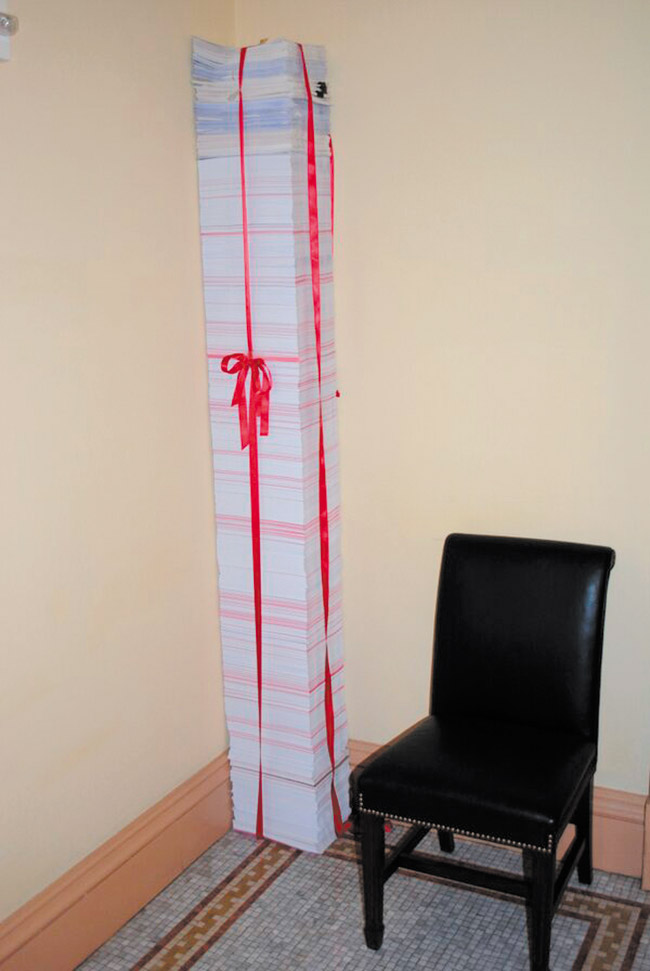
OK, cumbersome and impossible that somebody wouldn’t run afoul of some of those pages of regulation. But overall, we were on the road to something akin to national healthcare, right?
Oh, then came the exemptions. This business and that union didn’t have to comply with this or that regulation right now. But the general citizenry would have to. Oh, the sign-up system didn’t work, so you get a year’s exemption while it’s fixed.
Oh, wait, sorry, you can’t keep the health insurance plan you had, when President Obama repeatedly said you could. People we all knew had very minimal-coverage plans that could no longer be sold by participating insurers.
Oh, and you signed up and got a subsidy because of low income. Last year you got a better-paying job. Now you owe Uncle Sam a refund and you don’t have that in the bank and have to borrow money. So maybe an exemption this time? We’re up to 4 million people exempted, 3 percent of the population — half who signed up last year.
Then there are the Medicare cuts and the quality-instead-of-quantity care directive. Individual doctors are dumping Medicare patients. They and hospitals are graded on results with sick patients. Great. But you and I know many patients aren’t health-minded. They won’t change diets. They ignore critical medicines. The issue is worse in poor and immigrant neighborhoods.
Why should my doctor get penalized if I’ll do nothing to keep my blood pressure and weight under control?
If Medicare Advantage is forced to eliminate gym memberships, how does that help me to keep healthy?
Obamacare became a mess.
We healthcare progressives have to start acknowledging that in public.
We wanted national, single-payer healthcare.
Many of us have it. It’s already out there. It’s called Kaiser Permanente. We could have taxed citizens and made that a shining star system.
Not 20,000 pages. Just a slim document of your benefits. All your medical records on one computer server. Your choice of doctors.
President Obama had the right idea.
But unlike Franklin D. Roosevelt with the Social Security Act and Lyndon Johnson with the Civil Rights Act, he wimped out with Congress.
[so what now? Bob Jones?]
Saturday, February 14, 2015
Brian Williams
NBC News said Tuesday it has suspended its chief anchor and managing editor Brian Williams immediately for six months without pay, forgoing the option of firing the embattled newsman for now due to his popularity and past work at the network.
"As I'm sure you understand, this was a very hard decision," wrote NBC News President Deborah Turness in a memo distributed to staff members late Tuesday. "Certainly there will be those who disagree. But we believe this suspension is the appropriate and proportionate action."
Lester Holt, who was tapped to fill in while Williams sat out, will continue to serve as substitute anchor of NBC Nightly News. Williams took himself off the air Saturday after soldiers revealed that his account of being on a Chinook helicopter that went down during the U.S. invasion of Iraq was not true.
"We felt it would have been wrong to disregard the good work Brian has done and the special relationship he has forged with our viewers over 22 years," Turness said. "Millions of Americans have turned to him every day, and he has been an important and well-respected part of our organization."
Williams replaced Tom Brokaw in 2004 as NBC Nightly News anchor after working as a reporter at the network since the early 1990s. Mixing serious journalism with occasional appearances on late night talk shows, Williams has helped NBC Nightly News retain its lead over competitors. Despite the overall drop in evening news viewership over the years, NBC Nightly News averages about 9 million to 10 million viewers a night, edging ABC's World News Tonight and CBS Evening News.
The scandal erupted earlier this month when Williams attended a New York Rangers game with a soldier who helped guard him and other American soldiers while a convoy of military helicopters they were flying on was forced to land on a desert in Iraq in 2003.
Williams said the helicopter he was on had been hit by enemy fire and forced down. Veterans from the convoy challenged Williams' story — which he has repeated in the past — on Facebook. And the anchorman recanted the story on air Wednesday after Stars and Stripes wrote a story about their online exchange and interviewed Williams and the veterans.
***
and more?
Monday, February 02, 2015
Kauai's electricity
While
NextEra Energy's $4.3 billion bid to buy Hawaiian Electric Industries
dominates the local energy debate, a group of Hawaii island
residents is quietly investigating another possible future for their
utility. They are
turning for inspiration to Kauai, where pioneering folks banded together
in a cooperative and bought their electric utility for $215
million in 2002 in a completely debt-financed deal.
"We had
zero equity," recalled Dennis Esaki, who runs an engineering company and
was a founding director of the nonprofit Kauai Island Utility Cooperative. "We didn't have any money. It was an amazing feat."
At first he ducked when people called about the idea of buying the electric company.
"I didn't take their phone calls," he said in an interview. "I figured they must think I got money that I don't have."
By the Numbers
Kauai Island Utility Cooperative is a not-for-profit electrical co-op owned and controlled by the members it serves.
>> $215 million: Cost of the utility when purchased in 2002
>> 33,000: Member-owners, who are its customers >> $80 million: Equity stake owned by members >> $30 million: Returned to members since 2002 >> 9: Elected board members
Source: Kauai Island Utility Cooperative
|
But he decided to join the effort. The cooperative got rolling with $200,000 fronted by a Lihue businessman, Gregg Gardiner, and the support of the National Rural Utilities Cooperative Finance Corp. which put up $2 million and financed the acquisition.
Since its
launch 12 years ago, the nonprofit Kauai Island Utility Cooperative has
returned $30 million to its members, who are its customers, money
that is left at the end of the year after expenses are met. And it has
built up more than $80 million in equity, the members' ownership
stake.
"Main
thing is, we don't have off-island owners that the profits go out to,
like an investor-owned utility," Esaki told a forum in Hilo last
month. "All of the profits, called margins in this business, stay on the
island."
The co-op
is guided by a board elected by its 33,000 ratepayers, who each get one
vote. It has aggressively pursued solar power and focused on rate
stability.
Residential
electricity cost 34.1 cents per kilowatt-hour on Kauai in January,
compared with 35.9 cents on Hawaii island, 35.1 cents on Maui and
29.5 cents on Oahu, where there are economies of scale.
Kauai's
residential electricity rates fell by 1.6 percent from 2008 to 2013
while Hawaiian Electric Co.'s rose by more than 21 percent,
according to KIUC, which crunched data from the Public Utilities
Commission.
Subscribe to:
Posts (Atom)