Thursday, June 27, 2013

Senate passes immigration reform bill

WASHINGTON — The Senate on Thursday approved the most significant overhaul of the nation’s immigration laws in a generation with broad support generated by a sense among leading Republicans that the party needed to join with Democrats to remove a wedge between Republicans and Hispanic voters.

The strong 68-32 vote in the often polarized Senate tossed the issue into the House, where the Republican leadership has said that it will not take up the measure and is instead focused on much narrower legislation that would not provide a path to citizenship for the 11 million unauthorized immigrants in the country. Party leaders hope that the Senate action will pressure the House.

Leading up to the final votes, which the senators cast at their desks to mark the import of the moment, members of the bipartisan “Gang of Eight” who drafted the framework of the legislation took to the Senate floor to make a final argument for the measure. Among them was Senator Marco Rubio of Florida, one of the Republicans leading Hispanic voices.

When Rubio finished, the other senators in the group surrounded him on the floor, patting him on the back and offering words of encouragement. “Good job,” one said. “I’m proud of you,” another offered.

The future will show whether voters in Republican presidential primaries share that pride.

Monday, June 24, 2013

here comes ObamaCare

[7/21/13] Gordon Ito, state insurance commissioner, may be feeling a bit under the gun these days.

Just around the corner lurks the implementation of the Patient Protection and Affordable Care Act, more commonly called the ACA or "Obamacare," so naturally people want to know from Ito how much they'll be paying for health insurance in the near future.

At the earliest, people won't see that bottom line until Oct. 1, when the Hawaii Health Connector, like other online insurance marketplaces developed in states nationwide, is due to open for business under the new federal law. And that will spell things out for individuals and small businesses that are eligible for the online exchange, not for people who get their insurance as most now do, through their employer.

Employer groups are still in discussions with insurance carriers about pricing for benefit packages under the new rules, which may hinge more directly on factors such as the age of the workers. But Ito does have one clear message he offers, meanwhile.

"When people ask about rates, the first thing I say is, ‘Don't shoot the messenger!'" he said, drawing laughs from the attentive audience.

[7/2/13] The White House on Tuesday delayed for one year the new requirement under the Affordable Care Act that businesses provide health insurance to employees, a fresh setback for President Obama’s landmark health-care overhaul as it enters a critical phase.

The provision, commonly known as the employer mandate, calls for businesses with 50 or more workers to provide affordable quality insurance to workers or pay a $2,000 fine per employee. Business groups had objected to the provision, which now will take effect in January 2015.

[6/24/13 ] WASHINGTON (AP) - Fewer than 100 days before uninsured Americans can sign up for coverage, Health and Human Services Secretary Kathleen Sebelius said Monday the administration is gearing up with new call centers, a revamped website - and a confab with the National Football League.

No deals yet, Sebelius told reporters. But she said the idea of partnering to publicize the benefits of health insurance has gotten an enthusiastic reception from the NFL and other pro sports leagues.

Health promotion is a goal for the leagues and "good for the country," Sebelius said.

Football season would be in full swing Oct. 1, when consumers can start shopping for coverage under President Barack Obama's health care overhaul. Benefits take effect Jan. 1, around the time of the playoffs.

Opponents are looking for a goal-line fumble by the Obama administration as the long-awaited expansion of coverage for the uninsured finally happens. But if Sebelius is nervous, she doesn't let on.

"It's a huge undertaking across the country, and I'm confident we're going to get it done," she said. Not only sports leagues, but community organizations, religious denominations and public health groups will be involved with outreach.

Starting Oct. 1, consumers will be able to access new online marketplaces through HealthCare.gov and shop for private insurance plans in their communities. The federal government site will be the main portal to the new law, since about half the states are letting Washington run the coverage expansion.

Middle-class people who don't have job-based coverage will use the marketplace to apply for tax credits to help pay their premiums — a process that's supposed to take place smoothly and in close to real time, though skeptics doubt it. Low-income people will be steered to an expanded version of Medicaid in states that accept it.

All told, it's the biggest expansion of the social safety net since the creation of Medicare and Medicaid nearly 50 years ago. With polls showing that the law remains unpopular, and even many uninsured don't think they'll be helped, things are likely to get off to a slow start.

About 7 million people are expected to sign up for coverage in the new marketplaces next year, also called exchanges. That number is projected to more than triple in a few years.

Saturday, June 22, 2013

Healthcare costs slowing down?

There have been 2,470 mentions of the phrase "spiraling health care costs" in the media over the last year, according to Google. But as investor Eddy Elfenbein points out, medical costs are doing anything but spiraling. "Healthcare costs have outrun the cost of everything else for decades," he writes. "Suddenly, that trend has come to an end. Over the last year, healthcare costs have actually trailed broader consumer prices."

The year-over-year change in the medical care portion of the Consumer Price Index is now at the lowest level in 40 years.

Or as Eddy points out, medical care is growing slower than core inflation for the first time in decades:

Wednesday, June 19, 2013

40% of food uneaten in the U.S.

New York Mayor Michael Bloomberg’s plan to require residents to compost their food waste may cause headaches for some families, but experts say it could also help cut their rising grocery bills.

Under the proposal, by 2016 the city will require residents to separate their food waste for collection. Organic waste in New York City — which could otherwise be recycled for fertilizer or natural gas — currently accounts for 1.2 million tons or 35% of landfills, and a pilot program on Staten Island achieved a participation rate of 43%, according to the mayor’s office. Last year, Vermont introduced a bill to by 2020 require residents to recycle their food waste — and 33% of the organic waste in that state already gets composted.

Aside from the environmental advantages of composting, the effort may also be a boon for pocketbooks. Throwing out separate bags filled only with uneaten food could work as a big wake-up call for consumers, experts say. “We have a tendency to overbuy and overcook,” says Phil Lempert, CEO of grocery information site SupermarketGuru.com. “Awareness of how much food you’re wasting does help people buy properly. As prices go up, people also become more aware.” And consumers today have every reason to be more judicious in the grocery store. The price of food purchased for consumption at home is expected to rise 2.5% to 3.5% in 2013, according to the U.S. Department of Agriculture.

As much as 40% of food goes uneaten in the U.S., according to estimates from the Department of Agriculture and the Environmental Protection Agency. Americans are, in other words, throwing out the equivalent of $165 billion in wasted food every year, according to a recent analysis by the Natural Resources Defense Council, a nonprofit environmental group. In fact, one study estimates, just 15% of wasted food would be enough to feed more than 25 million Americans every year. And one in six Americans currently lacks a secure supply of food, says Dana Gunders, an NRDC project scientist in San Francisco.

Grocery bills are the biggest household expense. The average American family of four spends between $632 and $1,252 per month on grocery bills, according to the Department of Agriculture’s April 2013 “Cost of Food” survey. Composting forces people to actually see how much food they’re throwing away and how much money they’re wasting, says Andrew Shakman, president of LeanPath, a Portland-based company that tracks food waste in industrial kitchens. LeanPath helped cut food waste at the University of California, Berkeley, campus by 43%.

There are, of course, easier ways to cut one’s supermarket bill than composting. Consumers can waste less food by bringing a calculator to the store, making a note of when food goes bad, cooking only what they need and eating their leftovers, experts say. iPhone apps like Green Egg Shopper ($3.99) and Food Storage & Shelf Life ($1.99) can help keep track of perishables. One caveat to Bloomberg’s plan, however: “Recycling can also give less conscientious people a good excuse to waste,” Shakman says.

-- via twitter

Friday, June 14, 2013

Hawaii's population mix

Hawaii has the highest percentage of Asians (or part-Asians) of any state in the United States, far outsurpassing California 56.9% to 15.8%.  It also has the lowest percentage of whites (or part-whites) of any of the states (including Washington D.C.) at 43.8%.

However I believe Caucasians (or hapa) make up the highest percentage of any race over Japanese.

If you can classify Caucasian as a race that is.  Maybe not.  If you classify Caucasian as a race (which includes United States, Canadians, German, Italian, French, etc.), then I guess you could classify Asian as a race (included Chinese, Japanese, Korean, Filipino, etc.)  I dunno.

Suffice to say, Hawaii is the most mixed state in the United States.

Thursday, June 13, 2013

affordable care act may be unaffordable

WASHINGTON » It's called the Affordable Care Act, but President Barack Obama's health care law may turn out to be unaffordable for many low-wage workers, including employees at big chain restaurants, retail stores and hotels.

That might seem strange since the law requires medium-sized and large employers to offer "affordable" coverage or face fines.

But what's reasonable? Because of a wrinkle in the law, companies can meet their legal obligations by offering policies that would be too expensive for many low-wage workers. For the employee, it's like a mirage — attractive but out of reach.

The company can get off the hook, say corporate consultants and policy experts, but the employee could still face a federal requirement to get health insurance.

Many are expected to remain uninsured, possibly risking fines. That's due to another provision: the law says workers with an offer of "affordable" workplace coverage aren't entitled to new tax credits for private insurance, which could be a better deal for those on the lower rungs of the middle class.

Some supporters of the law are disappointed. It smacks of today's Catch-22 insurance rules.

"Some people may not gain the benefit of affordable employer coverage," acknowledged Ron Pollack, president of Families USA, a liberal advocacy group leading efforts to get uninsured people signed up for coverage next year.

"It is an imperfection in the new law," Pollack added. "The new law is a big step in the right direction, but it is not perfect, and it will require future improvements."

Wednesday, June 12, 2013

Aloha Medical Mission

Aloha Medical Mission has been saving and changing lives for 30 years, both abroad and in Hawaii with a free dental clinic at Palama Settlement.

At AMM’s annual gala on May 17, Art Ushijima, president of Queen’s, Michael Gold, president of HMSA, and Dr. Brad Wong, president of AMM will be honored for their support.

Monday, June 10, 2013

Academy of Pacific (AOP) shutting down

The Academy of the Pacific, a small private school in Alewa Heights, is shutting down due to financial struggles, the school’s board chairman announced today.

“Due to declining enrollment and increased financial pressures on families leading to greater need for tuition assistance, the school can no longer financially sustain itself nor continue to offer our students the very best in 21st century education,” Board Chairman Barron Guss said in a statement.

The nondenominational school, which served about 100 students in grades 6 through 12, was established to serve “creative and outside-the-box learners,” according to the school’s website. It charged tuition of $17,700.

While Guss said the board would “explore a variety of future possibilities,” a letter posted on the school’s website says the campus will “indefinitely cease academic operations” effective for the upcoming 2013-14 school year.

Tuesday, May 21, 2013

Obamacare and small businesses

NEW YORK (CNNMoney) It's been uttered by every opponent of health care reform: Obamacare will kill small businesses.

But the new law's rules don't apply to the vast majority of small businesses. The employer mandate, which forces firms to start providing insurance in 2014, pertains only to companies with at least 50 full-time workers.

That's a tiny fraction of small businesses.

As of 2010, there were roughly 5.7 million small employers, defined as those with fewer than 500 workers. Some 97% of them have fewer than 50 employees. That means Obamacare's employer mandate applies only to 3% of America's small businesses.    

If they don't provide insurance, businesses with 50-plus workers face $40,000 in penalties and $2,000 for each additional full-time employee.

However, nearly all of those businesses already do provide insurance: 96% of those with 50-plus workers currently offer health plans anyway, according to government data.

That most businesses affected by the mandate already provide insurance doesn't necessarily mean their insurance is good enough or sufficiently cheap under new Obamacare rules. That's the counterpoint made by U.S. Senator John Barrasso, a Republican from Wyoming.

"The mandates are for a lot more coverage than the average person would want, need or can afford. The business is going to have to spend time, money and have to figure that out," Barrasso said.

But there are signs that most plans out there qualify under Obamcare's other requirement. More than 99% of those in work-sponsored plans have insurance that meets most Obamacare coverage standards, according to last year's study by the University of Chicago's National Opinion Research Center.

Putting it all together, the data shows that only a tiny sliver of the nation's small businesses face the new rules -- and even fewer face any changes. Of the country's 6.5 million workplaces, only 1% must actually start providing insurance next year.

tornado hits Oklahoma City

Moore, Oklahoma (CNN) -- Amid downed power lines, hissing gas pipes and immense devastation, rescuers searched "board by board" Tuesday for survivors and victims of a massive tornado that pulverized a vast swath of the Oklahoma City suburbs.

It was a daunting task. The Monday afternoon storm carved a trail through the area as much as two miles wide and 17 miles long, officials said. Hardest hit was Moore, Oklahoma -- a suburban town of about 56,000 and the site of eerily similar twisters in 1999 and again four years later.

The scene -- block after block of flattened homes and businesses, the gutted remains of a hospital and hits on two elementary schools -- left even seasoned veterans of Oklahoma's infamous tornadoes reeling.

The devastation was so complete, Moore Mayor Glenn Lewis said city officials were racing to print new street signs to help guide rescuers and residents through a suddenly twisted and unfamiliar landscape.

Lt. Gov. Todd Lamb likened the destruction to a "two-mile-wide lawnmower blade going over a community."

Sunday, May 12, 2013

water bill rising

Anne Niethammer and other homeowners at her East Oahu condominium complex were just getting used to higher water rates put in place in 2012 when she noticed another change on her bill earlier this year.

In a transition from its previous two-month billing cycle, the Hono­lulu Board of Water Supply in January began collecting a fixed "billing" charge on a monthly basis, effectively doubling the amount paid by consumers.

Niethammer and most other Board of Water Supply residential customers used to pay the fee — currently $7.02 — once every two months. Now they pay it once a month.

"It really caught us off guard," Niethammer said. "It's a huge new source of revenue for them. Instead of $7 times six months, it's now $7 times 12 months," she said.

The seven-member Board of Water Supply board of directors voted in November 2011 to double the billing charge for most residential customers as part of a five-year rate-hike plan that went into effect in January 2012. The BWS held off on doubling the billing charge until January of this year, when it switched to the new monthly billing cycle, said BWS spokes­woman Tracy Burgo.

The additional revenue from the billing charge will be used to cover the cost of a new billing system, maintenance and repairs to automatic meter-reading equipment, new customer services such as online bill-viewing and bill-paying, and other expenses, Burgo said. The BWS has more than 170,000 customers.

"I know this is a difficult situation, and we do empathize with our customers," Burgo said. "We are customers, too."

The bad news for BWS customers is that the billing charge is going to continue to rise. Beginning July 1 the now-monthly fee goes up to $7.70; to $8.44 on July 1, 2014; then to $9.26 on July 1, 2015.
In January 2012, when bills were sent out every two months, the fee was $6.40, rising to $7.02 six months later.

The increase in the billing charge is the smallest part of three BWS bill increases customers are absorbing. The water portion of the bill and the sewage portion are also increasing.

In 2011 the board approved a 70 percent increase in water rates over five years. In 2010 the City Council approved a 29 percent increase in sewer fees from fiscal 2011 through fiscal 2016.

The increases in water, sewage and billing charges combined will push the average bill for a household using 13,000 gallons of water a month to $190.57 a month by fiscal 2016, from $155.63 a month today.

The BWS decided to switch to a monthly billing cycle in the midst of the increases. That was done for several reasons, including allowing the BWS to more quickly identify unusual water usage resulting from leaks, said Burgo. The new billing cycle also allows customers to "better align" their water/sewer bill payments with other bills, according to the BWS website.

Thursday, May 09, 2013

Mark Sanford

Former South Carolina Governor Mark Sanford is the guy who told his wife he was going for a hike and then went to Argentina to see his girlfriend. He was exposed as an unethical, lying, cheating weasel. In a stunning comeback, he has been elected to Congress, where he’ll fit right in.

-- Jay Leno, Tonight Show

Stephen Colbert’s whole world has been rocked by his sister Elizabeth Colbert Busch’s loss to Mark Sanford in this week’s special election in South Carolina’s First Congressional district.

That’s the way Mr. Colbert acted on his show Wednesday night in any case, and we have to say it was so convincing there seemed to be truth peeking out from behind his blustering on-screen persona.

“Tonight I am angry, and for once that doesn’t make me happy,” he said. “My sister lost. How could this happen? I was so sure Lulu had won, because CNN called it for Sanford.”

As a result, Colbert said he was renouncing his South Carolina-hood, and becoming a North Carolina Tar Heel, “whatever the [bleep] that means.”

Then he renounced the renunciation after tasting North Carolina barbeque, which he described as a “sauce-less, vinegar-based meat product.”

Sunday, May 05, 2013

a new day (or not)

After approving generous pay raises for themselves, state administrators, judges and unionized public workers, legislators failed to pass a promised hike in the state's $7.25-an-hour minimum wage. It set the theme for this year's Legislature: Let them eat our shorts.

The so-called "bird poop bill" to regulate the feeding of wild birds on private property died when House and Senate negotiators couldn't agree on its wording. It was only a matter of time before our legislators made it official that they can't get their poop together.

-- Dave Shapiro, 5/5/13

Thursday, April 25, 2013

POTS * 5

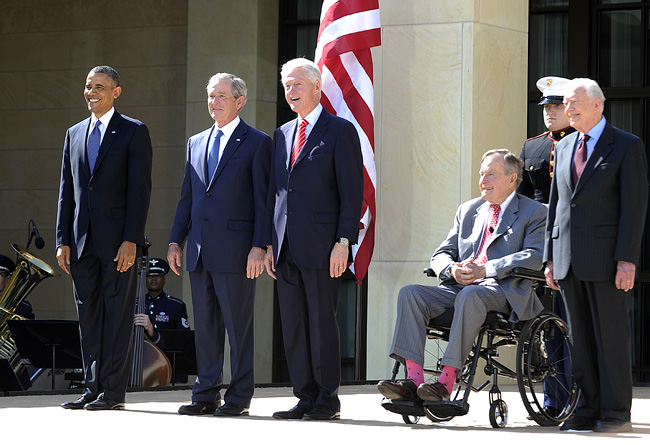
DALLAS (AP) — President Barack Obama on Thursday praised his predecessor at the dedication of his library for showing strength and resolve in the days after the Sept. 11 attacks and said if Congress passes immigration reform "it will be in large part thanks to the hard work of President George W. Bush."

Obama spoke along with all four living former presidents in a rare reunion honoring one of their own at the opening of the George W. Bush Presidential Center. "To know President George W. Bush is to like him," Obama said.

The presidents - Bush, Barack Obama, Bill Clinton, George H.W. Bush and Jimmy Carter - were cheered by a crowd of former White House officials and world leaders as they took the stage together to open the dedication. They were joined on stage by their wives - the nation's current and former first ladies - for the outdoor ceremony on a sun-splashed Texas morning.

It was a day for recollections and reveries, and no recriminations or remorse.

The five men have been described as members of the world's most exclusive club, but Obama said they are "more like a support group."

"Being president above all is a humbling job," Obama said. He there were moments that they make mistakes and wish they could turn back the clock, but "we love this country and we do our best."

The leaders put aside the profound ideological differences that have divided them for years for a day of pomp and pleasantries. For Bush, 66, the ceremony also marked his unofficial return to the public eye four years after the end of his deeply polarizing presidency. "Oh happy day," Bush said as he took the stage.

the unequal society

The United States is an unequal society. According to the Congressional Budget Office, the top 20 percent get about half the nation’s income, compared to the 5 percent of all income shared among the bottom fifth of households. The top 10 percent of the population controls about 70 percent of the wealth. Among rich countries, America’s inequality is certainly extreme. But the world as a whole is an incredibly unequal place. Norway—held up as a model of equality—still sees the bottom fifth of households with incomes less than a third (PDF) those of the top fifth.

Why is there such inequality? The choices we make as individuals can put us considerably above or below our peer average in terms of income or happiness or status. But our peer average itself is set by forces beyond our control—factors such as to whom we were born. And our peer average explains our relative standing against national averages far more than our own choices.

*** [6/11/13]

The net worth of the average American went from $194,000 in 1962 to $564,000 in 2007 (inflation adjusted).  However the median net worth went from only $52,000 in 1962 to $108,000 in 2007.  What's worse the average dropped to $464,000 in 2010 and the median dropped to $57,000, the lowest in 41 years.

Sunday, April 21, 2013

something is rotten in Denmark

Denmark has among the highest marginal income-tax rates in the world, with the top bracket of 56.5 percent kicking in on incomes of more than about $80,000. But in exchange, the Danes get a cradle-to-grave safety net that includes free health care, a free university education and hefty payouts to even the richest citizens.

Parents in all income brackets, for instance, get quarterly checks from the government to help defray child-care costs. The elderly get free maid service if they need it, even if they are wealthy.

But few experts here believe that Denmark can long afford the current perks. So Denmark is retooling itself, tinkering with corporate tax rates, considering new public sector investments and, for the long term, trying to wean more people — the young and the old — off government benefits.

“In the past, people never asked for help unless they needed it,” said Karen Haekkerup, the minister of social affairs and integration, who has been outspoken on the subject. “My grandmother was offered a pension and she was offended. She did not need it.

“But now people do not have that mentality. They think of these benefits as their rights. The rights have just expanded and expanded. And it has brought us a good quality of life. But now we need to go back to the rights and the duties. We all have to contribute.”

Monday, April 15, 2013

Boston Marathon bombing

BOSTON >> Two bombs exploded in the crowded streets near the finish line of the Boston Marathon today, killing at least three people and injuring more than 140 in a bloody scene of shattered glass and severed limbs that raised alarms that terrorists might have struck again in the United States.

A White House official speaking on condition of anonymity because the investigation was still unfolding said the attack was being treated as an act of terrorism.

President Barack Obama vowed that those responsible will "feel the full weight of justice."

As many as two unexploded bombs were also found near the end of the 26.2-mile course as part of what appeared to be a well-coordinated attack, but they were safely disarmed, according to a senior U.S. intelligence official, who also spoke on condition of anonymity because of the continuing investigation.
The fiery twin blasts took place about 10 seconds and about 100 yards apart, knocking spectators and at least one runner off their feet, shattering windows and sending dense plumes of smoke rising over the street and through the fluttering national flags lining the route. Blood stained the pavement, and huge shards were missing from window panes as high as three stories.

"They just started bringing people in with no limbs," said runner Tim Davey of Richmond, Va. He said he and his wife, Lisa, tried to shield their children's eyes from the gruesome scene inside a medical tent that had been set up to care for fatigued runners, but "they saw a lot."

"They just kept filling up with more and more casualties," Lisa Davey said. "Most everybody was conscious. They were very dazed."

As the FBI took charge of the investigation, authorities shed no light on a motive or who may have carried out the bombings, and police said they had no suspects in custody. Officials in Washington said there was no immediate claim of responsibility.

the one man tax rate

In 1935, president Roosevelt set a special 79% tax rate on those earning more than $5 million a year. According to historian Mark Leff, only one man in America made that much money over the following three years: John D. Rockefeller, Jr.

[More from the article:]

The federal government collected tax receipts equal to 15.8% of GDP in 2012. That's less than the average of 17.7% since 1945, and a touch below the 16% average of the last decade.

But perhaps more important than the amount of taxes collected is how the burden has shifted. In 1950, corporate taxes made up 27% of revenue, and payroll taxes brought in 11%. By 1980, it was 12.5% and 30.5%, respectively. And by 2011, corporate taxes made up 7.9% of revenue, while payroll taxes made up 35.5%:

Saturday, April 13, 2013

China and USA agree on North Korea

(Reuters) - The United States said on Saturday that China had agreed to work together to rid North Korea of its nuclear capability by peaceful means, but Beijing made no specific commitment in public to pressure its long-time ally to change its ways.

U.S. Secretary of State John Kerry met China's top leaders in a bid to persuade them to push reclusive North Korea, whose main diplomatic supporter is Beijing, to scale back its belligerence and, eventually, return to nuclear talks.

Before travelling to Beijing for the first time as secretary of state, Kerry had made no secret of his desire to see China take a more active stance towards North Korea, which in recent weeks has threatened nuclear war against the United States and South Korea.

Kerry and China's top diplomat, State Councillor Yang Jiechi, said both countries supported the goal of denuclearizing the Korean peninsula.

"We are able, the United States and China, to underscore our joint commitment to the denuclearization of the Korean peninsula in a peaceful manner," Kerry told reporters, sitting next to Yang at a state guesthouse in western Beijing.

But North Korea has repeatedly said it will not abandon nuclear weapons which it described on Friday as its "treasured" guarantor of security.

Monday, April 08, 2013

Margaret Thatcher

London (CNN) -- Former British Prime Minister Margaret Thatcher, a towering figure in postwar British and world politics and the only woman to become British prime minister, has died at the age of 87.

She suffered a stroke Monday, her spokeswoman said. A British government source said she died at the Ritz Hotel in London.

Thatcher's funeral will be at St. Paul's Cathedral, with full military honors, followed by a private cremation, the British prime minister's office announced.

Thatcher served from 1975 to 1990 as leader of the Conservative Party. She was called the "Iron Lady" for her personal and political toughness.

Thatcher won the nation's top job only six years after declaring in a television interview, "I don't think there will be a woman prime minister in my lifetime."

During her time at the helm of the British government, she emphasized moral absolutism, nationalism, and the rights of the individual versus those of the state -- famously declaring "There is no such thing as society" in 1987.

Nicknamed the "Iron Lady" by the Soviet press after a 1976 speech declaring that "the Russians are bent on world dominance," Thatcher later enjoyed a close working relationship with U.S. President Reagan, with whom she shared similar conservative views.

But the British cold warrior played a key role in ending the conflict by giving her stamp of approval to Soviet Communist reformer Mikhail Gorbachev shortly before he came to power.

Thatcher -- born in October 1925 in the small eastern England market town of Grantham -- came from a modest background, taking pride in being known as a grocer's daughter. She studied chemistry at Oxford, but was involved in politics from a young age, giving her first political speech at 20, according to her official biography.

She was elected leader of the Conservative Party in 1975, when the party was in opposition.

She made history four years later, becoming prime minister when the Conservatives won the elections of 1979, the first of three election victories to which she led her party.

As British leader, Thatcher took a firm stance with the European Community -- the forerunner of the European Union -- demanding a rebate of money London contributed to Brussels.

Her positions on other issues, both domestic and foreign, were just as firm, and in one of her most famous phrases, she declared at a Conservative Party conference that she had no intention of changing her mind.

"To those waiting with bated breath for that favorite media catchphrase, the U-turn, I have only one thing to say: 'You turn if you want to. The lady's not for turning,'" she declared, to cheers from party members.

[CNN video]

Bitter Pill

Read the feature in the March 4 issue of Time magazine, Steven Brill’s “Bitter Pill: How Outrageous Pricing and Egregious Profits Are Destroying Our Health Care.” It’s long, but it’s worth the reader’s slog, for Brill looks closely at dozens of hospital bills from across the country. What he found were not nonprofit institutions devoted solely to the health of their patients, but profit centers that charge scandalous sums for pills, gauze, ointments and procedures.

How scandalous? A head scan that in Canada costs $122 will bring a U.S. hospital $510. An appendectomy in high-priced Switzerland will cost $5,840, compared to $13,003 in the United States. And a coronary bypass that puts a Frenchman back $16,140 will require $67,583 to get around a U.S. blockage.

According to Brill, the results don’t justify the prices we pay. In 2010, America spent more than $8,000 per person on health care; the Japanese, less than half that much. An American can expect to live to be 79; a resident of Japan, to 83. All the world’s developed countries do as well or better than the United States on the longevity scale, despite the U.S. spending $750 billion more on health care than all the other developed nations spend combined.

Thursday, April 04, 2013

gun control bill passed in Connecticut

[4/4/13] Connecticut Gov. Dannel Malloy signed the nation's most far-reaching gun control bill Thursday, the ceremony in Hartford concluding several emotional weeks of debate and compromise since the state was rocked and the world stunned by the mass murder of children in Newtown.

"This is a profoundly emotional day for everyone in this room," Malloy, a Democat, said moments before signing the bill. He added that he hoped the state's bipartisan effort would provide an example for Congress.

"When 92% of Americans agree that every gun sale should be subject to a background check, there is no excuse" not to make it federal law," Malloy said.

The bill adds more than 100 weapons to the state's ban on assault weapons, limits the capacity of ammo magazines and requires background checks for all weapon sales, including at gun shows.

It also establishes the nation's first statewide registry for people convicted of crimes involving dangerous weapons. Access to the registry would be available only to law enforcement.

Saturday, March 30, 2013

Family Health Hawaii

Former state Insurance Commissioner J.P. Schmidt has taken the job of CEO of Family Health Hawaii, a startup health insurance company, and said he hopes to have as many as 50,000 members in five years.
Family Health Hawaii, which is preparing to enter the Hawaii market in the next few months, will be the state's fifth commercial health insurer, competing with Hawaii Medical Service Association, Kaiser, Hawaii Medical Assurance Association and UHA (University Health Alliance).

Family Health Hawaii received conditional approval to sell insurance from the state's Prepaid Health Care Advisory Council on Thursday, said Paul Tom, council chairman. The council reviews health insurance plans to ensure they meet the requirements of the 1974 Prepaid Health Care Act, the law mandating employer-sponsored health insurance for full-time workers.

The new health plan will offer lower premiums for small businesses and help drive down the rates of other insurers as well, Schmidt said.

Hawaii's health insurance market is dominated by HMSA and Kaiser, which controlled 77 percent and 21 percent of the market, respectively, in 2010, according to the American Medical Association.
"We believe that our premiums will be very competitive and, in many cases, lower than what the current health insurers provide," Schmidt said.

"That is what our aim is. Family Health Hawaii has been set up with a very efficient structure — a structure that we believe will enable us to provide health insurance at a lower premium rate."

Tuesday, March 26, 2013

the doctor shortage

In the July 28 New York Times article “Doctor Shortage Likely to Worsen With Health Law” by Annie Lowrey and Robert Pear, the Association of American Medical Colleges reports that in 2015 the country will fall short by 62,900 doctors, “and that number will more than double by 2025, as the expansion of insurance coverage and the aging of baby boomers drive up demand for care.”

In five years the island of Hawaii will lose 32 percent of its current physicians, according to a survey published in the April Hawaii Journal of Medicine and Public Health. Its deciding issues are “financial sustainability, professional opportunities, community support and access to good K-12 schools,” according to a report by Karen L. Pellegrin, director of continuing/distance education and strategic planning at the University of Hawaii at Hilo College of Pharmacy.

In my opinion, this doctor crisis is a crime against the Hawaii people. Decisions that have been made by our Legislature for years are the cause. The state’s wasteful spending projects, an unfriendly business climate, the egregious General Excise Tax on goods and services, other high taxes and fees, a top-heavy school system and special interest “bargains” to buy union loyalties are directly related to our sky-high cost of living, low-rated schools and why we can’t retain doctors or attract businesses.

We now see how these reckless, self-serving practices by lawmakers directly connect to the very most fundamental measure of any successful community: a healthy population.

-- Susan Page, MidWeek September 26, 2012

***

It’s well-known in the health-care world that we have a looming doctor shortage, with a growing gap between the medical services we need and the doctors who can provide them.

This often gets chalked up to the Affordable Care Act: Expanding insurance, the thinking goes, will hugely increase demand for doctors’ services. It’s an issue I’ve written about, as have others.

New research in the Annals of Family Medicine throws some cold water on that theory: Researchers there suggest that it’s population growth and aging largely driving the demand for doctors, with the Affordable Care Act playing a more minor role.

Sunday, March 03, 2013

why democracy fails (and the fatal sequence)

democracy doesn't work...   (according to my cousin)

The $85B cuts required due to sequestration for this year is going to be done gradually and doesn't affect Social Security or the medical programs which is where the real adjustments have to be made to rein in the long term costs.  If you are aware of what is happening in Europe where austerity is cutting back gov't programs, the people are protesting in the streets.  Our politicians may be unable to agree on reducing govt spending until such time as when the gov't can't pay as in Europe and riots break out.

Someone wrote a book on the rise and fall of nations and it proves that history repeats.  People and politicians are programmed to repeat mistakes of the past.  There will always be a majority of people who wants something without working and politicians who pander to these people in order to be elected.  This is why democracy has never worked because it is the rule by the majority.

(and according to Joseph Farah)

It pains me when I hear President Bush and so many others talk about the need to spread democracy around the world.

America's founders knew what a rotten and corrupt system of government democracy was and did everything in their power to ensure our country would never become one.

Why is democracy rotten and corrupt?

"A democracy cannot exist as a permanent form of government. It can only exist until the voters discover that they can vote themselves largesse from the public treasury. From that moment on, the majority always votes for the candidates promising the most benefits from the public treasury with the result that a democracy always collapses over loose fiscal policy, always followed by a dictatorship. The average age of the world's greatest civilizations has been 200 years.

"Great nations rise and fall. The people go from bondage to spiritual truth, to great courage, from courage to liberty, from liberty to abundance, from abundance to selfishness, from selfishness to complacency, from complacency to apathy, from apathy to dependence, from dependence back again to bondage."

Even though no one is certain who first spoke or penned this statement, truer words were never uttered.

(nobody knows where the statement came from?)

from wikianswers

The truth is that despite their frequent use, the above text actually has its origins in two separate and independent quotes, and the author of the first half is, to date, unknown. With regard to the first quoted paragraph, the Library of Congress' Respectfully Quoted writes, "Attributed to ALEXANDER FRASER TYTLER, LORD WOODHOUSELEE. Unverified." The quote, however, appears in no published work of Tytler's.

And with regard to the second, the same book says "Author unknown. Attributed to Benjamin Disraeli. Unverified."

Looking further down the google search results, it is apparent that the above wikianswer was writtten by Loren Collins.

Frequently, "Why Democracies Fail" is quoted alongside "Fatal Sequence," often as a single passage attributed to Professor Tytler/Tyler. But all indications point to the two having separate origins. Firstly, unlike "WDF," "Fatal Sequence" is attributed to a wide variety of authors. In addition to Tytler/Tyler or Anonymous, I have seen the quote credited to Benjamin Disraeli (1804-1881), Arnold Toynbee (1889-1975), Ezra Taft Benson (1899-1994), Davis Paschall (1911-2001), Bernard Weatherill (1920-present) and Robert Muntzel (?-?). Secondly, while I have tracked both quotes back to the mid-20th century, the first instance I have found of them used together was in 1979.

But the person who appears to be the actual author of this passage is none of the men named above. They were not born from the mouth or pen of a political leader or historian or famous author. Rather, they would seem to be the words of Henning Webb Prentis, Jr., President of the Armstrong Cork Company.

... These facts lead me to suspect that these quotes were probably coined by separate individuals in the first half of the twentieth century, and I'm comfortable in concluding that Henning W. Prentis, Jr. is the author of the Fatal Sequence, unless further earlier evidence comes forward. In the original version of this article, when the evidence was inconclusive as to the author of either quote, I wrote that the authors of each half were most likely not famous persons or respected scholars, but rather just private political thinkers who got their words in print, and whose words then happened to strike a chord in others. The identification of Mr. Prentis as the author of FS bolsters this interpretation; the Fatal Sequence was not coined by a political figure or noted historian, but rather the president of a cork company. The passage of time merely encouraged quoters to attach an author's name that strengthened the authority behind the words.

And that is where the vice of misattribution lies. Perhaps the words speak the truth of democratic governments; or perhaps they do not. But either way, attributing the words to a scholar who never spoke them is to lend to them an authority and reliability that they do not deserve. Quotations should not be given fictitious attributions merely to lend credence to the messages they impart. To do so is to favor persuasiveness over accuracy, and to sacrifice truth for the sake of image.

Tuesday, February 26, 2013

Here's The Deal

David Leonhardt is one of the most thoughtful and coherent economic writers of our time -- you just might not recognize his name because he doesn't write much anymore.

Here's the Deal -- a short e-book that will set you back $1.99 -- lays the federal budget bare, exposing exactly what's causing our deficits, what poses the biggest risk to future deficits, and how we might address the nation's growing debt. He doesn't yell or spout ideology. He uses numbers.

"Eventually," Leonhardt writes, "the country will have to confront the deficit we have, rather than the deficit we imagine. The one we imagine is a deficit caused by waste, fraud, abuse, foreign aid, oil-industry subsidies and vague out-of-control spending. The one we have is caused by the world's highest health costs (by far), the world's largest military (by far), a Social Security program built when most people died by age 70 -- and, to pay for it all, the lowest tax rates in decades."

[I thought everybody knew that..  Maybe, but they're not really addressing it.  OK, maybe not.]

Sunday, February 24, 2013

bombing works

In the fall of 1972, Democrat Sen. George McGovern was running for the presidency against incumbent Republican Richard Nixon. From his campaign rhetoric, it was clear to the Vietnamese Communists they could get more concessions from McGovern at the ongoing Paris peace talks than from Nixon, so they were literally rooting for him. But when Nixon defeated him soundly, the Communists skulked away from Paris and suspended the negotiations.

In early December after the election, Nixon – in order to pressure the Communists back to the table – began bombing the immediate Hanoi area with B-52 bombers (a quantum escalation). Of course, the American anti-war media called it the “Christmas bombing.” As bombs fell within blocks of Hoa Lo Prison, pieces of plaster and debris fell from the ceilings of our cell blocks, but we POWs cheered on the bombers, knowing force was the only thing to which the Communists would respond. And after only three weeks, they did. They signed the Paris Peace Accords, which essentially ended the war, and prescribed the means for the release of all POWs.

-- Jerry Coffee, Midweek, February 6, 2013

Thursday, February 14, 2013

medicare a good deal

(for the recipients).  And that's the problem...

It's not surprising that we can't pass a bill to address long-term budget deficits. Effectively all of the growth in projected long-term budget spending is health care costs tied to Medicare benefits. And -- surprise! -- voters really like Medicare benefits. According to a 2010 poll by the Tax Policy Center, three-quarters of Americans think entitlements like Medicare will create major economic problems over the next 25 years. But two-thirds oppose reducing benefits, and more than half oppose raising taxes.

Here's why: Medicare isn't just a good deal for retirees. It's an outstanding deal.

According to the Urban Institute (link opens PDF), a couple with average wages retiring at age 65 in 2010 would have paid $88,000 in dedicated Medicare taxes over the course of their lifetimes (including their employers' share) but can expect to receive $387,000 in Medicare benefits. A 65-year-old couple retiring in 2020 will have paid $111,000 in Medicare taxes and can expect to receive $427,000 in benefits.

Medicare taxes for most workers are currently 2.9% of income, where they've been since 1986. But median wages during that time grew by an average of 2.8% per year, while medical costs grew by an average of 5.5% per year. In order to have kept an equal ratio of Medicare taxes to Medicare expenditures over the last three decades, either taxes would need to have doubled or expenditure growth would need to have been cut in half. But remember the Tax Policy Center poll: Voters by and large refuse both options. This is why we have deficits.

That sentiment will probably grow in the future. In 1970, 10% of the U.S. population was age 65 or older. Today that's 14%, and by 2030 nearly 20% of the economy will be eligible for Medicare. How do you think these people are going to vote? Will they easily give up their investment-of-a-lifetime Medicare benefits? I doubt it.

There are a few likely ways this will end. Raising the age at which you become eligible for benefits is one of the more palatable options, but it doesn't do much to the deficit, as a disproportionate amount of health care costs are incurred when people are in their 70s and 80s. Growth in health care costs is coming in below what budget analysts expected. If that trend holds, most of the runaway-spending budget forecasts could be proven too pessimistic. More likely, Medicare growth will come at the expense of other government programs -- nondefense discretionary spending is already on track to hit a 50-year low as a share of GDP.

But here's what we know: The budget isn't hard to fix because politicians are evil or because one political party "doesn't get it." It's hard because what drives long-term deficits are programs that offer voters deals they can't refuse. Just pay a little now, and we'll give you a lot tomorrow -- who can turn that down? It's a dangerously good deal.

Wednesday, February 06, 2013

no mail for you (on Saturday)

The financially struggling U.S. Postal Service said today it will stop delivering mail on Saturdays but continue to disburse packages six days a week, an apparent end-run around an unaccommodating Congress.

The service expects the Saturday mail cutback to begin the week of Aug. 5 and to save about $2 billion annually, said Postmaster General and CEO Patrick R. Donahoe.

"Our financial condition is urgent," Donahoe told a press conference.

The move accentuates one of the agency's strong points — package delivery has increased by 14 percent since 2010, officials say, while the delivery of letters and other mail has declined with the increasing use of email and other Internet services.

Under the new plan, mail would be delivered to homes and businesses only from Monday through Friday, but would still be delivered to post office boxes on Saturdays. Post offices now open on Saturdays would remain open on Saturdays.

Over the past several years, the Postal Service has advocated shifting to a five-day delivery schedule for mail and packages — and it repeatedly but unsuccessfully appealed to Congress to approve the move. Though an independent agency, the service gets no tax dollars for its day-to-day operations but is subject to congressional control.

Congress has included a ban on five-day delivery in its appropriations bill. But because the federal government is now operating under a temporary spending measure, rather than an appropriations bill, Donahoe says it's the agency's interpretation that it can make the change itself.

"This is not like a 'gotcha' or anything like that," he said. The agency is essentially asking Congress not to reimpose the ban when the spending measure expires on March 27 and he said he would work with Congress on the issue.

The agency clearly thinks it has a majority of the American public on its side regarding the change.
Postal Service market research and other research indicated that nearly 7 in 10 Americans support the switch to five-day delivery as a way for the Postal Service to reduce costs, the agency said.

The agency in November reported an annual loss of a record $15.9 billion for the last budget year and forecast more red ink in 2013, capping a tumultuous year in which it was forced to default on billions in retiree health benefit prepayments to avert bankruptcy.

The financial losses for the fiscal year ending Sept. 30 were more than triple the $5.1 billion loss in the previous year. Having reached its borrowing limit, the mail agency is operating with little cash on hand.
The agency's biggest problem — and the majority of the red ink in 2012 — was not due to reduced mail flow but rather to mounting mandatory costs for future retiree health benefits, which made up $11.1 billion of the losses. Without that and other related labor expenses, the mail agency sustained an operating loss of $2.4 billion, lower than the previous year.

The health payments are a requirement imposed by Congress in 2006 that the post office set aside $55 billion in an account to cover future medical costs for retirees. The idea was to put $5.5 billion a year into the account for 10 years. That's $5.5 billion the post office doesn't have.

No other government agency is required to make such a payment for future medical benefits. Postal authorities wanted Congress to address the issue last year, but lawmakers finished their session without getting it done. So officials are moving ahead to accelerate their own plan for cost-cutting.

The Postal Service is in the midst of a major restructuring throughout its retail, delivery and mail processing operations. Since 2006, it has cut annual costs by about $15 billion, reduced the size of its career workforce by 193,000 or by 28 percent, and has consolidated more than 200 mail processing locations, officials say.

***

Why would the USPS take such radical measures? The simple truth is that the postal service is a fundamentally sound business, though not without its challenges. If you look closely, you'll see a concerted campaign to drive USPS out of business, despite the fact that it operates without government subsidies and, potentially, at a profit. It's being subjected to a politically manufactured crisis in order to ram through drastic change. But without the USPS, citizens will face much higher costs without better service. Below, I outline three common misconceptions about the USPS and explain why they're misleading.

Sunday, January 27, 2013

senators agree on principles of immigration reform

[5/21/13] The most far-reaching US immigration legislation in about two decades moved forward on a solid bipartisan vote in the Senate judiciary committee after supporters avoided a controversy over the rights of gay spouses.

The 13-5 vote cleared the way for a full Senate showdown on one of President Barack Obama's top domestic priorities and gives the opposition Republican party a chance to recast itself as more appealing to minorities.

"Yes, we can! Sí, se puede," immigration activists shouted after the vote, reprising Obama's campaign cry in his historic run for the White House in 2008.

In addition to creating a pathway to citizenship for 11.5 million immigrants living illegally in the country, the legislation creates a new program for low-skilled foreign labour and would permit highly skilled workers into the country at far higher levels. At the same time it requires the government to take costly new steps to guard against future illegal immigration.

Obama said the legislation was "largely consistent with the principles of common-sense reform I have proposed and meets the challenge of fixing our broken immigration system".

Republicans have embraced the idea of immigration reform after a large majority of Hispanic voters supporters Obama in the 2012 election, leading to concerns that the party was out of touch with a younger, more diverse country.

***

[1/17/13] A bipartisan group of eight senators plans to announce they have agreed on a set of principles for comprehensive immigration reform.

The deal, which will be announced at a news conference Monday afternoon, covers border security, guest workers and employer verification, as well as a path to citizenship for the 11 million illegal immigrants already in this country.

The eight senators expected to endorse the new principles are Democrats Charles Schumer of New York, Dick Durbin of Illinois, Robert Menendez of New Jersey and Michael Bennet of Colorado; and Republicans John McCain of Arizona, Lindsey Graham of South Carolina, Marco Rubio of Florida and Jeff Flake of Arizona.

According to documents released early Monday, the senators will call for accomplishing four main goals:

--Creating a path to citizenship for the estimated illegal immigrants already in the U.S., contingent upon securing the border and better tracking of people here on visas.

--Reforming the legal immigration system, including awarding green cards to immigrants who obtain advanced degrees in science, math, technology or engineering from an American university.

--Creating an effective employment verification system to ensure that employers do not hire illegal immigrants.

--Allowing more low-skill workers into the country and allowing employers to hire immigrants if they can demonstrate they couldn't recruit a U.S. citizen; and establishing an agricultural worker program.

The principles being released Monday are outlined on just over four pages, leaving plenty of details left to fill in.

***

[4/16/13] (Reuters) - President Barack Obama on Tuesday embraced a sweeping overhaul of the nation's immigration system put forward by a bipartisan group of senators, saying it was "largely consistent" with his own principles for immigration reform.

The Democratic president, who had said previously that he would submit his own bill if he was not satisfied with the Senate proposal, urged Congress to "quickly move" the bill forward and pledged to do "whatever it takes" to help.

He spoke after meeting with two of the measure's chief sponsors, Senators John McCain, a Republican from Arizona, and Charles Schumer, a Democrat from New York.

Obama's endorsement and the bipartisan support for the bill improves its chances for passage but by no means ensures it.

The four Democrats and four Republicans sponsoring the bill likely face a months-long battle, with the biggest challenge expected in the Republican-led House of Representatives.


McCain, who lost the 2008 presidential election to Obama, warned that the defeat of any one of the key provisions of the complex legislation could jeopardize the whole effort.

He told reporters that it was "carefully crafted" to keep Republicans, Democrats and different interest groups on board and that if "certain things" were changed, "we would lose one side or the other."

For this and other reasons, Republican Senator Marco Rubio of Florida, another of the bill's sponsors, said the group planned on taking its time with the legislation.

"It's a complicated issue and I think people want to learn more about it," the Cuban-American lawmaker told reporters. "This will be a while. This is not going to be done in a week or quite frankly in a month."

Rubio's comment underscored the delicate construction of the proposal, which would create a new legal status for millions of undocumented immigrants, as urged by immigrant advocacy groups and large segments of the Democratic party.

But to lure Republican support, it conditions a path to permanent legal status - and ultimately a chance for citizenship - on the success of a multibillion-dollar effort to make U.S. borders less porous, using unmanned aerial surveillance, the construction of double and triple lawyers of fencing and the deployment of thousands of additional border patrol officers along with the National Guard.

To get business support, the bill would create a new system of visas for temporary agricultural workers and low-skilled laborers as well as expand the number of specialized, highly-trained foreigners allowed to enter the country to work for technology companies.

To avoid alienating fiscal conservatives in both parties, the proposal denies most federal benefits to the immigrants until they achieve permanent status in the United States, which could take 10 years.
Supporters insist that the bill would not provide an amnesty to illegal immigrants.

The eight senators are trying to pull together broad Republican and Democratic support in hopes that doing so will save the legislation from the fate of failed efforts to comprehensively reform immigration over the past three decades.

That strategy began to pay off Tuesday, even before the bill had been formally introduced.

Conservative anti-tax activist Grover Norquist, head of Americans for Tax Reform, was among those who praised the immigration reform effort. He said he would attend a news conference later this week sponsored by the bipartisan group of senators backing the bill.

"They are doing serious border security. They are making sure that the 10 or 11 million who are here without papers can stay and work as long they are not criminals as long as they're working. So you're weeding out bad guys and allowing people who are good and decent and hard-working to be able to stay and work and get in line in questions of citizenship ..."

Rather than being a cost to the country, the bill would be a "boon" to the economy and would save taxpayers money because those with the provisional visas won't be eligible for federal benefits, Norquist said.

The Senate proposal has been embraced by a range of groups, including the U.S. Chamber of Commerce, the AFL-CIO labor organization and immigrants rights activists.

The argument that the new law would be too costly has struck a chord with Tea Party conservatives and could become a central theme of opposition in the House.

"America's entitlement system is already on a sinking ship and it would be fiscally irresponsible to add another 10 million people to the public assistance rolls," said Debbie Dooley, co-founder of the Atlanta Tea Party.


Sunday, January 20, 2013

Inside Obama's Presidency

is a Frontline episode playing on PBS.

To me, it seems pro-Obama.  Democrats might think it's balanced.  Republicans would say it doesn't look at things from their viewpoint.

And maybe that's why the Republicans want to get rid of PBS, or at least the government subsidy of it (which is 15% according to this article).

Thursday, January 17, 2013

the smallest government spender?

It’s enough to make even the most ardent Obama cynic scratch his head in confusion.

Amidst all the cries of Barack Obama being the most prolific big government spender the nation has ever suffered, Marketwatch is reporting that our president has actually been tighter with a buck than any United States president since Dwight D. Eisenhower.

Who knew?

***

Or not

Tuesday, January 15, 2013

not just compassion?

Some of today’s money blandishments – unemployment compensation, food stamps, general welfare vouchers – are not just about compassion. They also are about keeping the 99 percent from confronting the 1 percent. We’re buying off people who might otherwise get very unruly.

Coxey’s huge army of the unemployed marched on D.C. in 1894 and almost brought down the government. The Bonus Army march of veterans in 1932 required troops to put it down.

Now, as we know from the Watts and Detroit riots, it doesn’t take much to get cities burning.

-- Bob Jones, September 12, 2012

***

Entitlements -- including Social Security, Medicare and safety net programs such as Medicaid and food stamps -- don't just benefit the poor and unemployed. More than 90% of the benefits go toward working families, the disabled and the elderly. And more than half of all entitlement spending helps middle class Americans.

In 2010, those age 65 and older collected 53% of the dollars, while the non-elderly disabled received 20%, according to the Center on Budget and Policy Priorities, a left-leaning group. And folks in working families collected 18%.

As for income levels, those in the middle -- earning between $30,000 and $120,000 -- received 58% of all entitlement dollars in 2010.

***

Just call me old-fashioned, or even that nasty “C” word conservative, in my thinking. I’m of the same era as Bob Jones and marvel that I could have grown up with such a different perspective on life. I grew up believing that you actually wanted to gain success in life, gained through your own hard work, and through that success, wealth and perhaps even community status. It was not considered to be something so abominable to become a solid business owner and/or to prosper from that business. If you failed at an endeavor, that failure was yours, not to be blamed on someone or something else. You took responsibility for you and yours.

I find most entitlement programs are based on political points rather than need – I live in a low income area and I see many folks working hard to survive. At the same time, I go into a local grocery store and see a young, seeming able-bodied young lady, gold bracelets up to her elbow, three children under the age of 8 and paying for a cart full of high-priced groceries with an EBT card, while her “boyfriend” brings the SUV around to pick them all up. I, meanwhile, am waiting my turn with a package of hot dogs and a can of beans because that’s what our budget allows this week. No complaints, we like canned beans, but simply an observation.

Nancy Calhoun, Waianae

Friday, January 11, 2013

Lex Brodie

Former businessman Lex Brodie, perhaps best known for his tire commercials ending with the catch phrase, “Thank you, very much,” died today at the age of 98.

Alexander “Lex” Hofgaard Brodie was born in Kekaha, Kauai.

Brodie retired in 1991 from his Lex Brodie's Tire Co., which still operates under his name. He is also a former president of Small Business Hawaii and a former member of the Board of Education.

He is survived by his wife, Evelyn; children, Wendy Pelligrini, Sandy Brodie, Robert Brodie, Janet Teves; seven grandchildren, five great-granddaughters and one great-great grandson.

Private services are planned through the Kauai Memorial Gardens & Funeral Home.

Here's a vintage Lex Brodie tire commercial from the Lex Brodie's YouTube channel.

***

HONOLULU (HawaiiNewsNow) - He was known for ending his commercials by saying, "Thank you...very much." Lex Brodie, longtime businessman and former member of the state Board of Education, died Friday morning on Kauai. He was 98.

Brodie has been an icon in Hawaii for decades, beginning in 1958 when he moved from managing the Dole Pineapple Cannery to owning a Chevron station in Kaneohe, on Kaneohe Bay Drive, where he started Lex Brodie's Tire Company in 1961.

He moved the company to its current location on 701 Queen Street in 1964. Some photos of Brodie, along with some of the business awards he won, were placed on his original office desk, along with lei, when news came of his passing.

Brodie retired from Lex Brodie's Tire Company in 1991. Brodie was also the campaign manager for Honolulu Mayor Jeremy Harris and served on the Board of Education from 1992-2003. He moved to Kauai after leaving the board.

Alexander Brodie was born on Kauai in 1914. According to his company, Brodie moved to Oahu and was in the first graduating class of Roosevelt High School. In 1933, he was one of the first Waikiki Beach Boys and was in business with Sam Kahanamoku, Duke's brother, giving canoe rides and surf lessons.

Brodie's phrase, "Thank you, very much," is still featured in the commercials and on several signs in the shop on Queen Street. "We can say it our own way, but only Mr. Brodie can say 'thank you very much' like he did. So we don't even try to copy that," said Williams. "We just try to emulate the high level of customer service that he laid for us."

Thursday, December 27, 2012

Schatz chosen over Hanabusa to replace Inouye

Lt. Gov. Brian Schatz, who is expected to be sworn in today as the late U.S. Sen. Daniel K. Inouye's successor, said Wednesday that he understands the magnitude of the appointment and promised the islands: "I won't let you down."

Gov. Neil Abercrombie selected Schatz on Wednesday over U.S. Rep. Colleen Hanabusa, who was Inouye's choice as his successor, and Esther Kia‘aina, the deputy director of the state Department of Land and Natural Resources.

Inouye, before he died Dec. 17 at 88 of respiratory complications, had asked Abercrombie in a letter to grant him his "last wish" by naming Hanabusa, 61, who represents urban Honolulu's 1st Congressional District. The letter was hand-delivered to the governor by Walter Dods, a retired banker, and Jeffrey Watanabe, a retired attorney and chairman of Hawaiian Electric Industries, two of the senator's closest confidants.

Several Democrats said privately that Abercrombie's decision could cause a schism within the party that could lead to a serious primary challenge to the governor or to Schatz.

Abercrombie is up for re-election in 2014. Schatz will serve until voters in 2014 elect a senator to fill out the remainder of Inouye's six-year term, which runs through 2016.

"Senator Inouye conveyed his final wish to Governor Abercrombie. While we are very disappointed that it was not honored, it was the governor's decision to make. We wish Brian Schatz the best of luck," Jennifer Sabas, Inouye's chief of staff, said in a statement.

Abercrombie said that Inouye's wishes were taken into account.

"The law makes explicitly clear, as does the rules of the Democratic Party, that while everyone's voice is heard, and everyone's view is taken into account, nonetheless, no one and nothing is preordained," he said.
The governor said Schatz's ability to build seniority in the Senate was a factor in his decision, as was the fact that a Hanabusa appointment would have triggered a winner-take-all special election that could have left the 1st District in Republican control. He also said that he took into consideration Hanabusa's post on the House Armed Services Committee, which is important because of the state's large military presence.

Asked afterward whether he may have ignited a civil war within the party, Abercrombie said: "If it is an issue for anybody, then I suggest they can take that to the people and present that as an argument. But I think, with regard to 2014, my view is that will take care of itself. My responsibility is to do the right thing by what is in the interest of the party, the state and the country as a whole."

Schatz said he has good relationships with Inouye's staff and would work toward a smooth transition.

Schatz said his priorities would be to continue to identify federal money for Hawaii, a Native Hawaiian federal recognition bill, and strategies to respond to global climate change.

"To the people of Hawaii, I can assure you this: I will give every fiber of my being to doing a good job for the state of Hawaii," Schatz said. "We have a long and perhaps difficult road ahead of us, but we can succeed if we work together. I understand the magnitude of this obligation and this honor. And I won't let you down."

Tuesday, December 25, 2012

the best year ever?

In so many ways, 2012 was another year of disappointments. Unemployment is still high. Average incomes are still low. Fear and distrust still dominate the discussion.

But the U.K's The Spectator takes a different view. It claimed in an article this week that 2012 "was the best year ever," explaining:

Never in the history of the world has there been less hunger, less disease and more prosperity. ... The West remains in the economic doldrums, but most developing countries are charging ahead, and people are being lifted out of poverty at the fastest rate ever recorded. ... The death toll inflicted by war and natural disasters is also mercifully low. We are living in a golden age.

***

More reads

Monday, December 17, 2012

Dan Inouye

Daniel K. Inouye died today of a respiratory ailment at a Bethesda, Md., hospital, ending a life of remarkable service for his country and Hawaii that included sacrificing his right arm in World War II combat and spending 50 years as a U.S. senator. He was 88.

The senator succumbed to respiratory complications at 5:01 p.m. Eastern time at the Walter Reed National Military Medical Center where he had been hospitalized since Dec. 9. Inouye was first brought to George Washington University Hospital on Dec. 6 after fainting in a Senate office. He was transferred to Walter Reed three days later.

A statement from his office said that his wife Irene Hirano Inouye and his son Ken were at his side and that last rites were performed by Senate Chaplain Dr. Barry Black.

When he was asked recently how he wanted to be remembered, he said, "I represented the people of Hawaii and this nation honestly and to the best of my ability. I think I did OK," according to the statement.

His last words were, "Aloha."